Sinusoidal Signals: Amplitude, Frequency, and Phase 🌊
Now that we know AC voltage swings back and forth, we need a precise way to describe how it does that.
In the real world, AC signals follow a very specific shape called a sine wave (or sinusoidal wave).
👉 Why this matters:
This shape tells us exactly how voltage and current change over time, which is the foundation of all AC circuit analysis.
What Is a Sine Wave?
A sine wave is a smooth, repeating oscillation that goes:
- Positive → zero → negative → zero → positive again

Almost all AC power and signal analysis assumes sine waves because nature itself produces them.
Why a Sine Wave?
When a coil of wire rotates in a magnetic field (the basic principle of an electrical generator), the induced voltage naturally follows a sine wave.
This isn’t a design choice — it comes directly from electromagnetic induction physics.
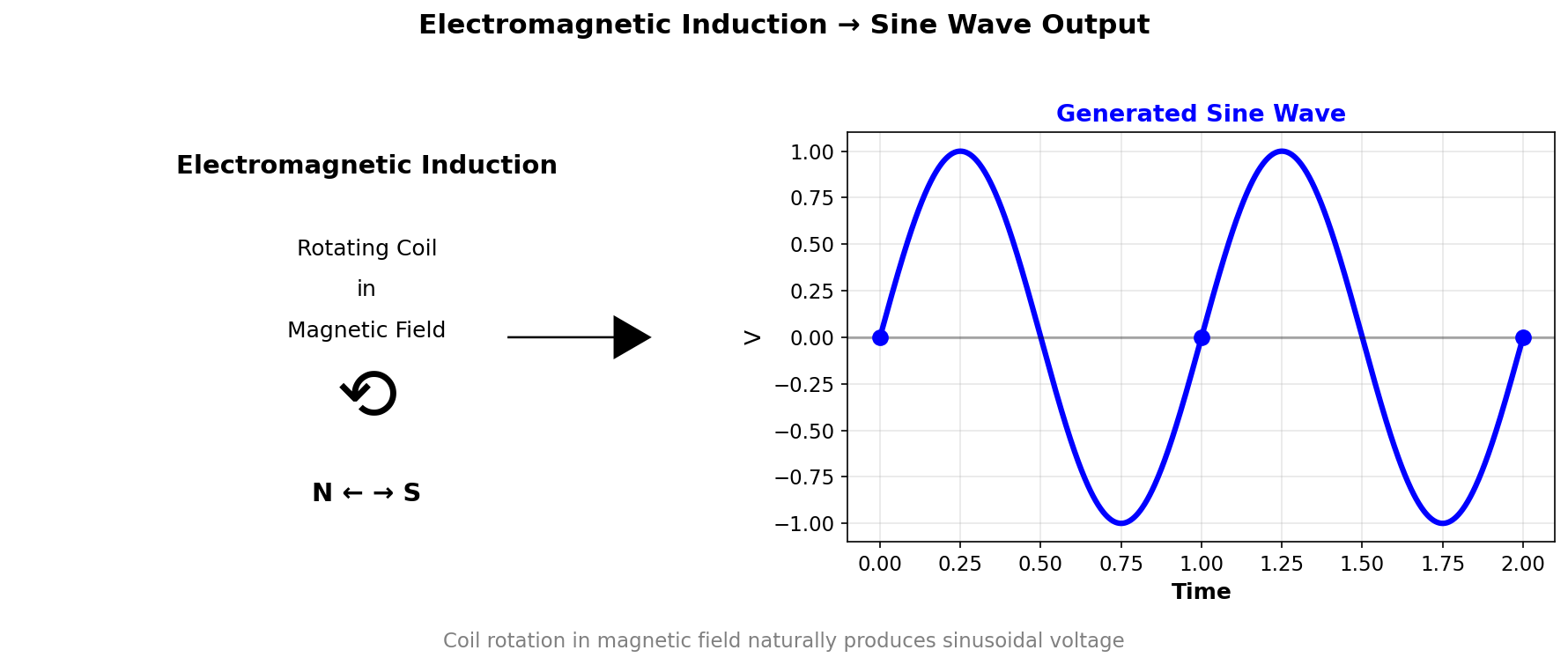
Because generators create sine waves naturally, AC power worldwide shares the same shape.
Amplitude (Peak Value)
Amplitude is the height of the wave — the maximum voltage or current reached.
Think of it like:
- Small waves → gentle water
- Big waves → powerful ocean swells

Key Points About Amplitude
- Determines signal strength
- Higher amplitude → more available power
- Measured from zero to peak
Example:
- Household power in the US is called 120 V AC
- But the peak voltage is ~170 V
120 V is the RMS value, not the peak.
We’ll cover RMS in the next lesson.
Frequency (How Fast It Repeats)
Frequency tells us how often the wave repeats.
- Measured in Hertz (Hz)
- 1 Hz = 1 cycle per second

Common AC Frequencies
| Region | Frequency |
|---|---|
| USA | 60 Hz |
| Europe / India | 50 Hz |
Intuition for Frequency
- Slow vibration → low frequency
- Fast vibration → high frequency
Just like:
- Slowly plucked guitar string → low frequency
- Tightly plucked string → high frequency
Different circuits behave very differently at different frequencies.
Phase (Where the Wave Is)
Phase describes where in the cycle a signal is at a given moment.
Two signals can:
- Have the same frequency
- Have the same amplitude
- But still be out of sync
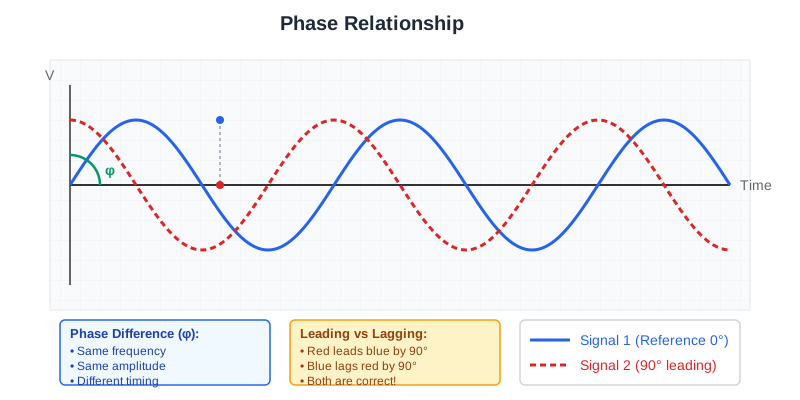
Phase Measurement
Phase is measured in:
- Degrees (0° to 360°)
- Radians (0 to 2π)
Common Phase Angles
| Phase | What It Means |
|---|---|
| 0° | Starts at zero, rising positive |
| 90° | Starts at positive peak |
| 180° | Starts at zero, going negative |
| 270° | Starts at negative peak |
A 180° phase shift means the signals are perfect opposites.
Why Phase Matters ⚙️
Phase becomes critical when multiple AC signals exist in the same system.
Three-Phase Power Example
Industrial power often uses three-phase AC:
- Three sine waves
- Same amplitude and frequency
- 120° phase-shifted from each other
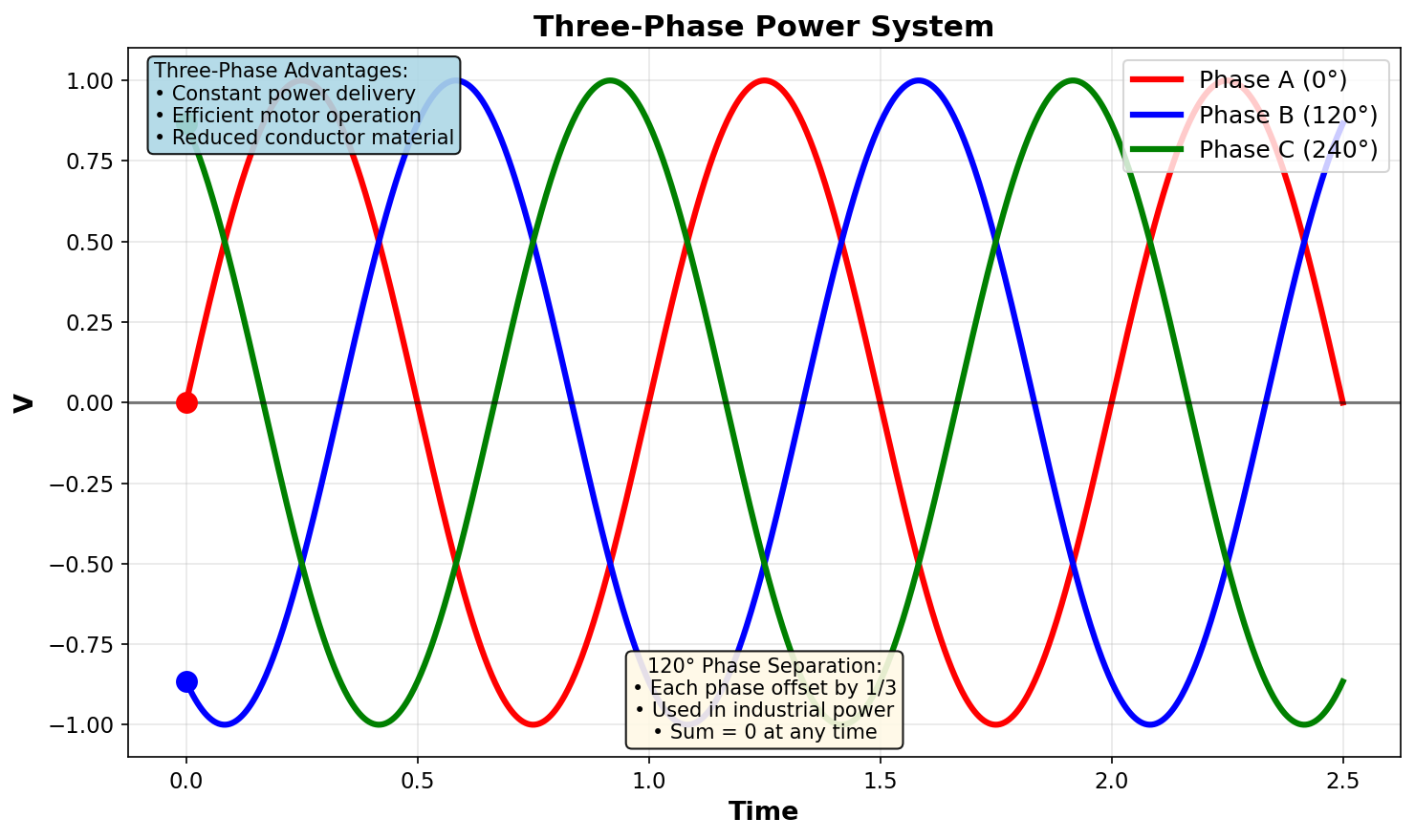
This provides:
- Smoother power delivery
- Higher efficiency
- Better motor performance
Putting It All Together
A complete AC signal description might be:
“A 120 V peak sine wave at 60 Hz with 0° phase offset.”
This tells you:
- Shape → sine wave
- Strength → amplitude
- Speed → frequency
- Starting point → phase
AC Signal Description Summary
| Parameter | Describes |
|---|---|
| Amplitude | Signal strength |
| Frequency | Speed of oscillation |
| Phase | Relative timing |
| Shape | How it varies over time |
Amplitude, frequency, and phase together fully describe any sinusoidal signal.
Key Takeaway
- AC signals follow sine waves
- Amplitude → how strong
- Frequency → how fast
- Phase → where it starts
- These three concepts explain all AC behavior
Master these, and AC circuits stop being mysterious —
they become predictable and controllable 🌊⚡