Fundamental Electrical Quantities & Symbols
Voltage, Current, Resistance, and Power: The Four Pillars of Electricity
Now that you understand electricity is just organized electron flow, we need to talk about how to measure and describe it.
Scientists and engineers have developed fundamental quantities to describe electrical behavior. These aren't just random numbers and symbols - they represent real, physical things happening in your circuits.
Let's learn each one.
⚡ Electric Charge (Q) - Measured in Coulombs
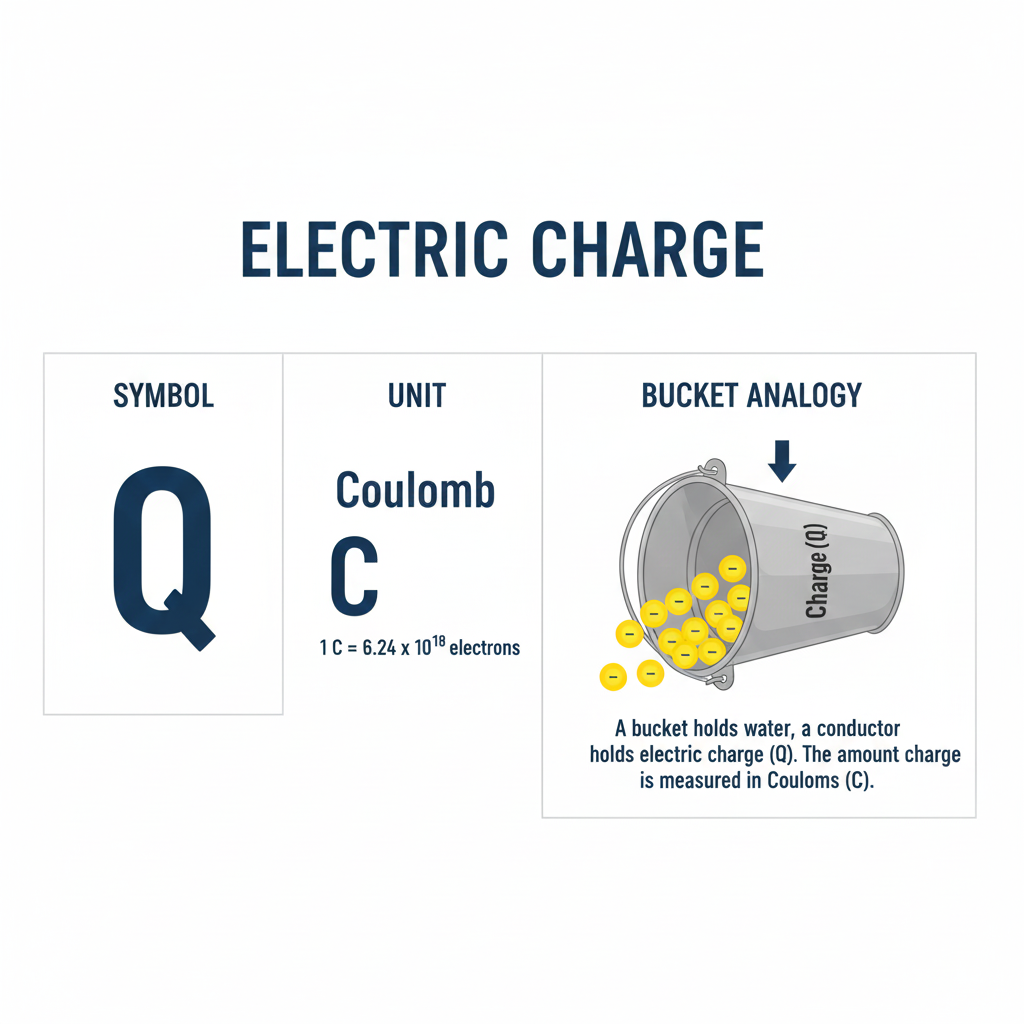
Electric charge is the total amount of electrical "stuff" - specifically, the amount of electrons.
Imagine you have a bucket, and you're filling it with water.
- Amount of water in bucket = Electric charge
- Unit: Coulombs (C)
- One Coulomb = 6.24 × 10¹⁸ electrons (6.24 billion billion!)
Symbol: Q
Example: When we write Q = 5 Coulombs, we're saying "we have the equivalent charge of 5 Coulombs worth of electrons."
| Property | Description |
|---|---|
| Symbol | Q |
| Unit | Coulombs (C) |
| What it measures | Total amount of electrons |
| Analogy | Amount of water in a bucket |
🌊 Electric Current (I) - Measured in Amperes
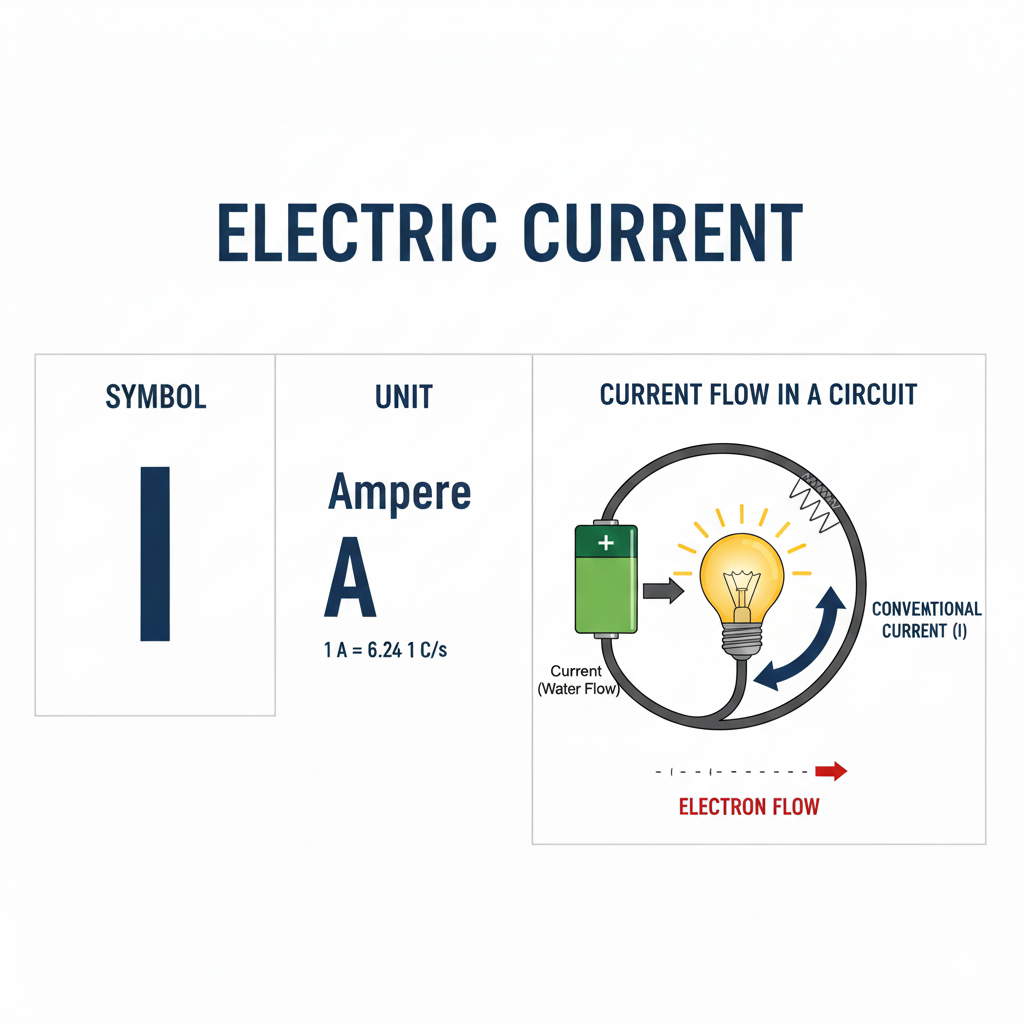
Charge is how much electrical "stuff" you have. Current is how fast it's moving.
Current is the rate at which charge flows past a point in a circuit. It's the speed of electron flow.
Think of it like a river:
- Amount of water in river = Charge
- Flow rate (how much water passes a point per second) = Current
Understanding Amperes
Unit: Amperes (Amps or A)
1 Ampere means: One Coulomb of charge flows past a point every second
1 Ampere = 1 Coulomb per second
Example: 2A flowing = 2 Coulombs of electrons passing a point every second
| Property | Description |
|---|---|
| Symbol | I |
| Unit | Amperes (A) |
| What it measures | Rate of charge flow |
| Formula | I = Q / t (charge per time) |
In circuit diagrams, we draw current flowing from positive → negative, even though electrons actually flow negative → positive. This is a historical convention we're stuck with!
⚡ Voltage (V) - Measured in Volts
Voltage is the electrical pressure or potential difference that pushes electrons to move.
This is often the most confusing quantity for beginners, so let's take our time.
The Water Tank Analogy
Think of a water system with two tanks at different heights:
| High Tank | Low Tank |
|---|---|
| More potential energy | Less potential energy |
| Height difference creates pressure | Pressure pushes water downward |
| Bigger height difference = stronger push | - |
In electricity:
- High electrical potential = one point
- Low electrical potential = another point
- Voltage = this difference in potential
- Creates electrical "pressure" that pushes electrons
Unit: Volts (V)
Examples:
5V battery→ 5 volts of potential difference between terminals12V battery→ 12 volts potential difference- Bigger voltage = stronger push on electrons
Symbol: V (sometimes U or E)
| Property | Description |
|---|---|
| Symbol | V (or U, E) |
| Unit | Volts (V) |
| What it measures | Electrical pressure/potential difference |
| Analogy | Water pressure from height difference |
🚧 Resistance (R) - Measured in Ohms
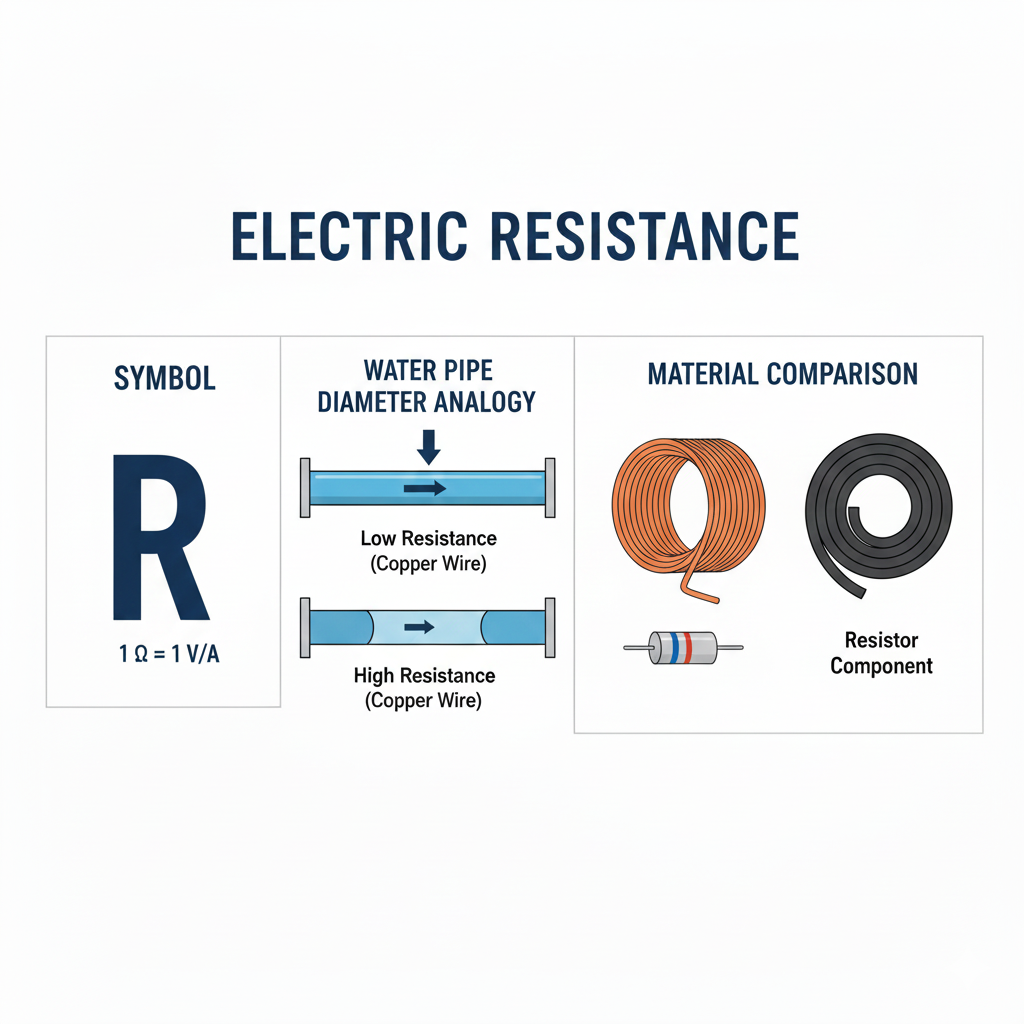
Resistance is the opposition to electron flow.
Not all materials let electrons flow equally easily. Some make it very easy (conductors), others make it very difficult (insulators).
The Pipe Analogy
| Wide, Smooth Pipe | Narrow, Rough Pipe |
|---|---|
| Water flows easily | Water flow difficult |
| Low resistance | High resistance |
Electrical resistance works the same way!
Unit: Ohms (Ω) - Greek letter Omega
| Resistance | Meaning |
|---|---|
| Small resistance | Electrons flow easily |
| Large resistance | Electrons flow with difficulty |
Symbol: R
| Property | Description |
|---|---|
| Symbol | R |
| Unit | Ohms (Ω) |
| What it measures | Opposition to electron flow |
| Material types | Conductor (low Ω), Insulator (high Ω) |
💡 Power (P) - Measured in Watts
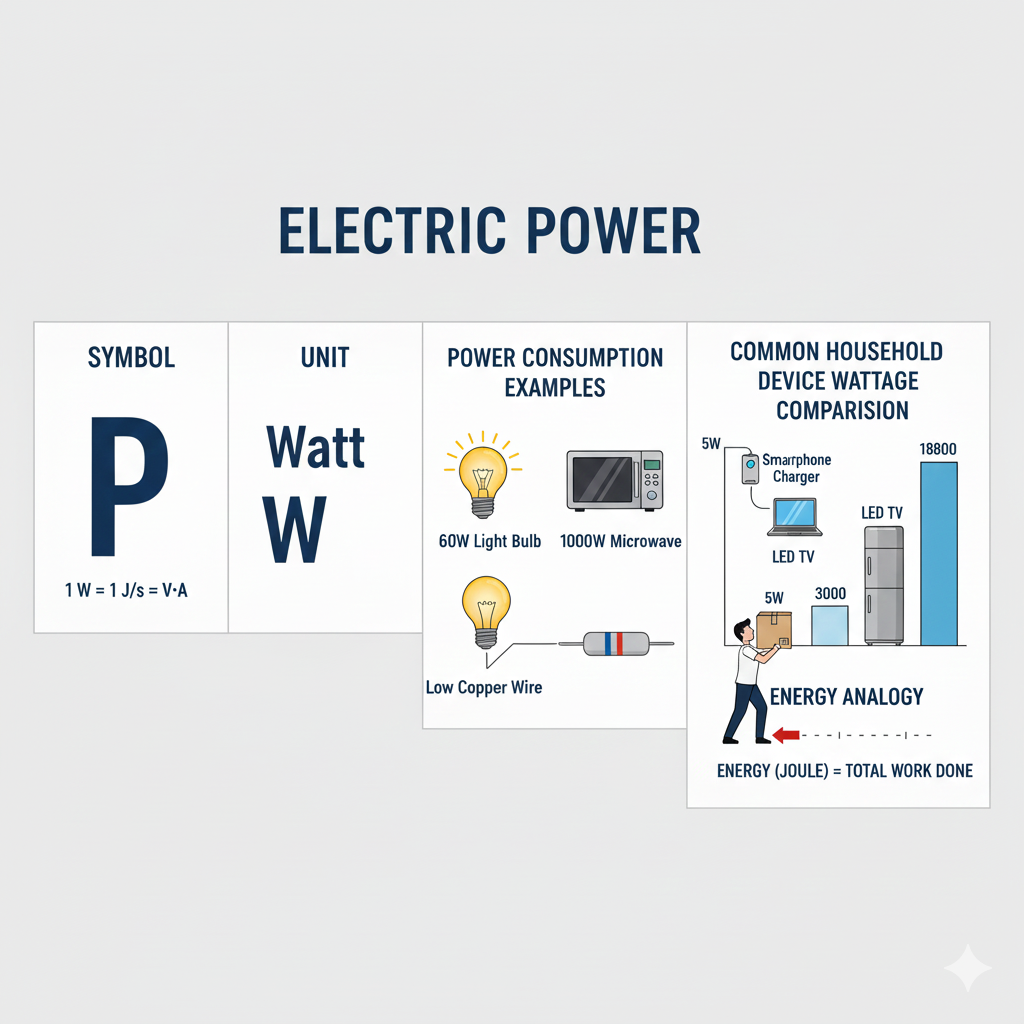
Power is how much work electricity is doing per second - how much energy is being transferred or consumed.
- Single drop of water falling = not very powerful
- Waterfall (millions of drops, continuously) = very powerful!
Electrical power works the same way.
Unit: Watts (W)
Common Examples:
60Wlight bulb = consumes 60 Watts1000Wmicrowave = consumes 1000 Watts (1 kilowatt)5WLED = consumes only 5 Watts
Symbol: P
| Property | Description |
|---|---|
| Symbol | P |
| Unit | Watts (W) |
| What it measures | Work done per second |
| Formula | P = V × I (voltage × current) |
🔄 How These Four Work Together
These four quantities don't exist independently. They work together to describe what's happening in a circuit:
| Quantity | Role | Description |
|---|---|---|
| Voltage (V) | The Push | What tries to make electrons flow |
| Resistance (R) | The Opposition | What tries to stop electrons from flowing |
| Current (I) | The Result | Actual electron flow (push vs opposition) |
| Power (P) | The Effect | How much work is being done |
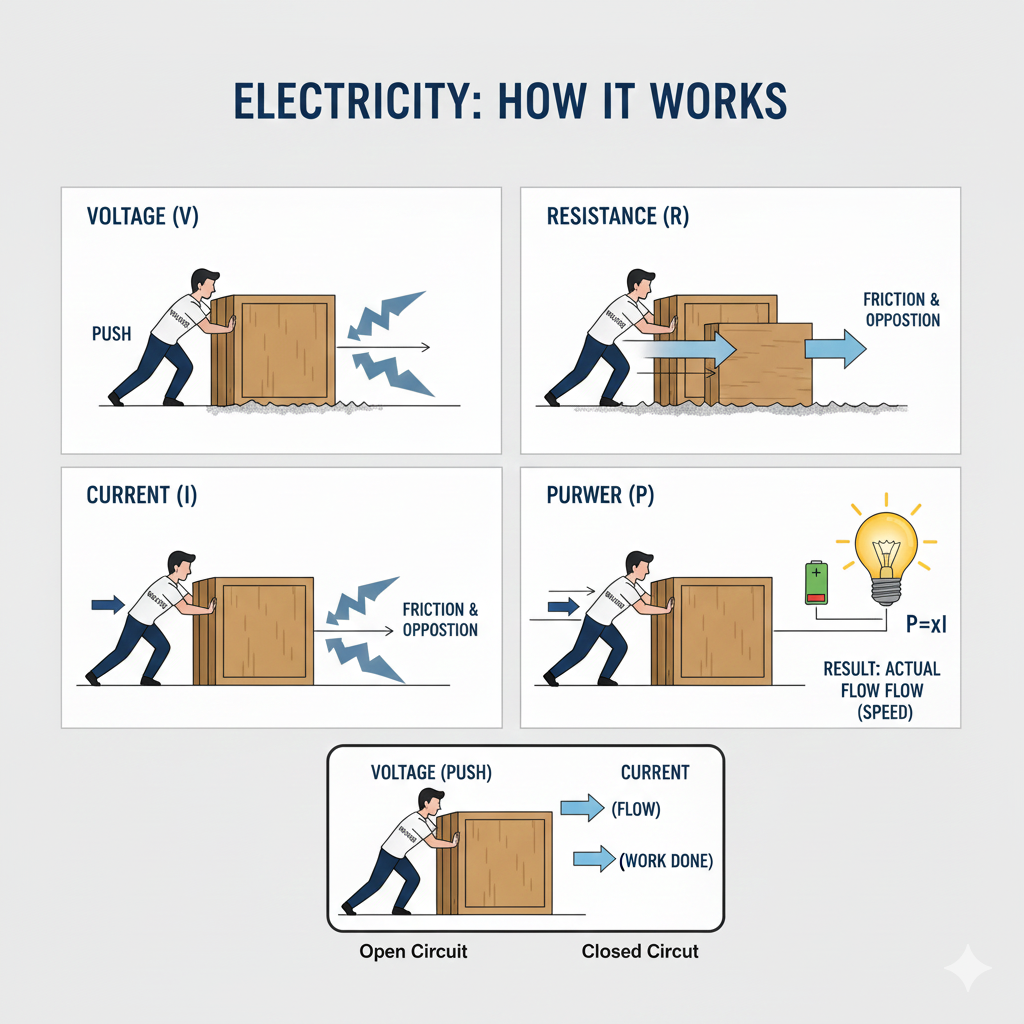
The Box-Pushing Analogy
Imagine you're pushing a heavy box across the floor:
- Force you apply = Voltage (the push)
- Friction and resistance of floor = Resistance (opposition)
- How fast box actually moves = Current (the result)
- Work you're doing = Power (energy per second)
🔧 Circuit Symbols and Diagrams
Now that you understand these quantities, let's talk about how we represent them in diagrams.
Engineers use specific symbols to represent different components in circuits. These symbols are standardized worldwide - any engineer can look at a circuit diagram and understand it!
Basic Circuit Symbols
| Component | Symbol Description | What it represents |
|---|---|---|
| Battery | Long and short lines | Long = positive (+), Short = negative (−) |
| Resistor | Zigzag line or rectangle | Opposes current flow |
| Capacitor | Two parallel lines || | Stores electrical charge |
| Switch | Line with break and lever | Opens/closes circuit |
| Wire | Simple line | Connects components |
| Ammeter | Circle with 'A' | Measures current |
| Voltmeter | Circle with 'V' | Measures voltage |
Don't dismiss these symbols as just abstract drawings.
These symbols let us communicate complex electrical behavior using simple visual language.
When you see a circuit diagram, you're seeing a map of how electricity flows and what it encounters along the way. Understanding the symbols is like learning to read a map.
📊 Quick Reference Summary
| Quantity | Symbol | Unit | Measures | Analogy |
|---|---|---|---|---|
| Charge | Q | Coulombs (C) | Amount of electrons | Water in bucket |
| Current | I | Amperes (A) | Flow rate | Water flow rate |
| Voltage | V | Volts (V) | Electrical pressure | Water pressure |
| Resistance | R | Ohms (Ω) | Opposition to flow | Pipe friction |
| Power | P | Watts (W) | Work per second | Waterfall power |
Voltage, current, resistance, and power are not separate things happening in different parts of your circuit.
They're different ways of describing the same phenomenon - the flow of electrons through a circuit.
Every single quantity is connected to the others through mathematical relationships (which we'll explore in the next lesson). For now, make sure you have a solid intuitive understanding of what each one means.