Ohm's Law – Understanding the Relationship Between Voltage, Current, and Resistance
Once we understand that electric current is nothing but the movement of electrons, the next natural question is: what controls how much current flows?
This is where Ohm's Law comes into the picture.
The Three Key Players
Imagine electrons as people trying to walk through a narrow corridor:
- Wide and smooth corridor → people walk easily
- Narrow or full of obstacles → movement becomes difficult
Electricity behaves in a very similar way.
Let's understand the three fundamental quantities that control electron flow:
⚡ Voltage (V)
The electrical pressure or "push" applied to electrons
- The force that tries to make electrons move
- Higher voltage = stronger push
- Encourages more electrons to move through the conductor
- Unit: Volts (V)
🌊 Current (I)
The actual flow of electrons
- Tells us how many electrons are moving at any given moment
- More electrons flowing = higher current
- Unit: Amperes (A or Amps)
🚧 Resistance (R)
The opposition offered by the material to electron flow
- Electrons collide with atoms, impurities, and structural imperfections
- These collisions slow them down and convert electrical energy into heat
- Unit: Ohms (Ω)
| Material Type | Resistance | Examples |
|---|---|---|
| Conductors | Very low | Copper, aluminum, silver |
| Insulators | Very high | Rubber, plastic, glass |
The Relationship: Ohm's Law
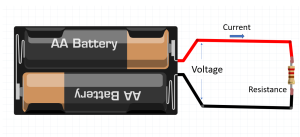
The current flowing through a conductor is:
- Directly proportional to the voltage applied
- Inversely proportional to its resistance
In simple terms:
- ⬆️ Increase voltage → ⬆️ Current increases
- ⬆️ Increase resistance → ⬇️ Current decreases
The Formula
Where:
- V = Voltage (Volts)
- I = Current (Amperes)
- R = Resistance (Ohms)
You can rearrange Ohm's Law to find any variable:
| To find: | Formula | Use when: |
|---|---|---|
| Voltage | V = I × R | You know current and resistance |
| Current | I = V / R | You know voltage and resistance |
| Resistance | R = V / I | You know voltage and current |
Why Ohm's Law Matters
This equation is not just a formula—it is a fundamental law that governs all electrical and electronic systems, from a simple torchlight to complex industrial machines.
Every time an engineer selects a resistor, wire thickness, power supply, or load, Ohm's Law is used in the background.
Real-World Applications
Understanding Ohm's Law helps you:
✅ Predict circuit behavior before you even build it ✅ Calculate safe current levels to prevent damage ✅ Prevent overheating in components ✅ Protect components from overcurrent ✅ Design efficient systems with optimal power usage
In the industry, all engineers use this basic formula to calculate the required resistance or the required current. All other parameters are derived from these fundamental units.
Example: Power (P) = Voltage (V) × Current (I)
This is the foundation for everything in electrical or electronic systems.
Practical Example
Let's say you have:
- A 9V battery (voltage)
- A resistor of 3Ω (resistance)
- How much current flows?
I = V / R
I = 9V / 3Ω
I = 3A
Answer: 3 Amperes of current will flow.
Always calculate current before connecting components! Too much current can:
- Overheat wires
- Damage components
- Create fire hazards
- Destroy sensitive electronics
Ohm's Law Becomes an Instinct
As you move forward into electronics, embedded systems, and mechatronics, you will realize that Ohm's Law is not something you "learn once and forget."
It becomes an instinct that guides every design decision you make.
You'll start to automatically think:
- "If I increase voltage here, current will increase..."
- "I need to add resistance to limit current..."
- "This component can't handle that much current..."
This intuitive understanding is what separates beginners from experienced engineers.
Now that you understand Ohm's Law, you're ready to explore:
- How components are connected (series and parallel)
- How to calculate power in circuits
- How to design safe, efficient electrical systems
The journey has just begun!