⚡ Power in AC Circuits — Real, Reactive, and Apparent Power
In DC circuits, power is simple: voltage and current work together all the time.
In AC circuits, voltage and current may be out of phase, so power splits into three different forms.
Understanding these is essential for efficiency, billing, and real-world electrical design.
🔌 Why AC Power Is Different from DC Power
In AC systems, reactive components (inductors and capacitors) store and release energy instead of consuming it.
Because of this energy exchange, voltage and current are often out of phase by an angle .
This phase difference changes how much power is actually useful versus how much is just circulating.
🔥 Real Power (P) — Useful Power
Real Power is the power that performs actual work like:
- Lighting a bulb
- Running a motor
- Heating a resistor
Only resistive elements consume real power.
Unit: Watts (W)
Formula:
Where:
- = RMS Voltage
- = RMS Current
- = Phase angle between voltage and current
| Voltage (V) | Current (A) | Phase Angle | Real Power (W) | |
|---|---|---|---|---|
| 10 | 1 | 1.0 | 10 | |
| 10 | 1 | 0.5 | 5 |
Insight:
Even with the same voltage and current, real power drops when phase angle increases.
🔄 Reactive Power (Q) — Circulating Power
Reactive Power represents energy that moves back and forth between:
- The source
- Capacitors and inductors
It does not perform useful work, but it:
- Increases current
- Causes copper losses
- Heats cables and transformers
Unit: Volt-Ampere Reactive (VAR)
Formula:
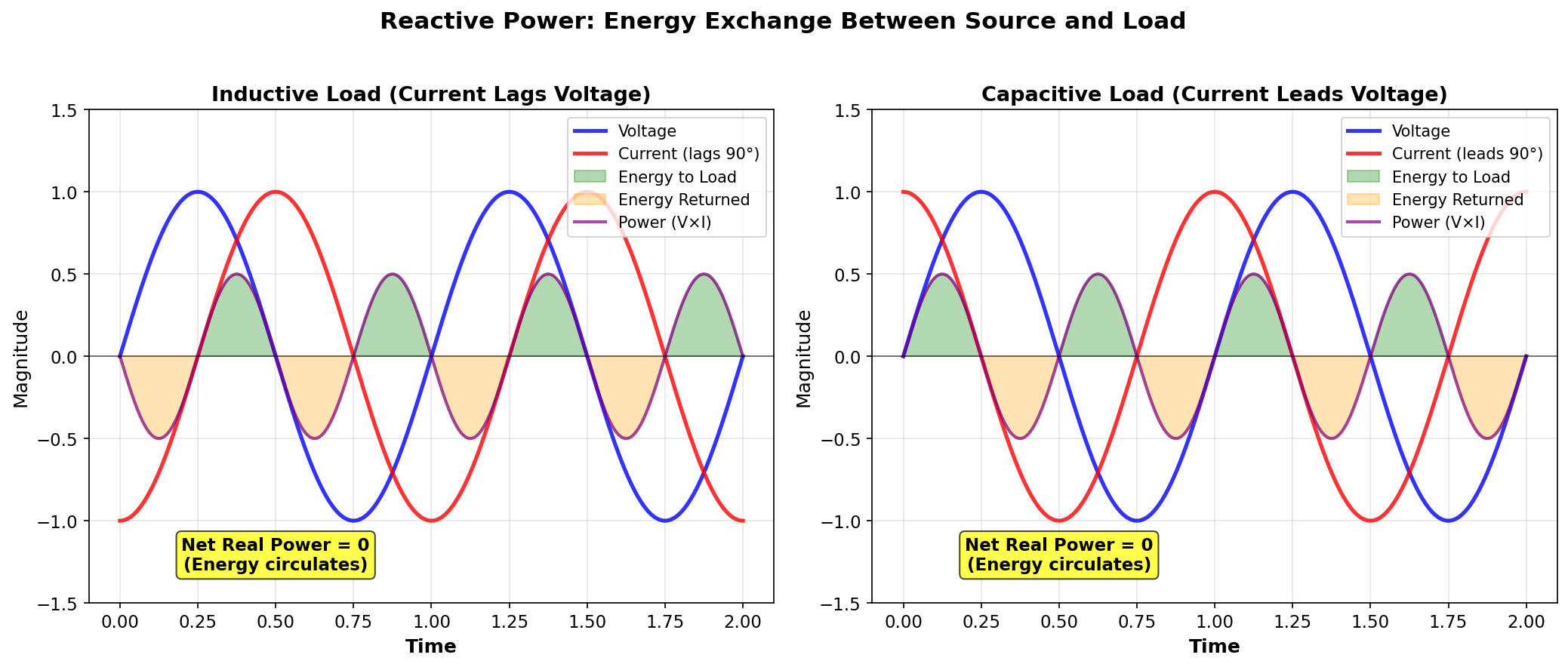
Reactive power:
- ❌ Does no useful work
- ❌ Increases losses
- ✅ Is reduced using power factor correction
📐 Apparent Power (S) — Total Power Seen
Apparent Power is the product of voltage and current without considering phase angle.
Unit: Volt-Amperes (VA)
Formula:
It represents the total load on generators, transformers, and cables.
| Voltage (V) | Current (A) | Apparent Power (VA) |
|---|---|---|
| 10 | 1 | 10 |
But real power may be much lower depending on .
📊 The Power Triangle
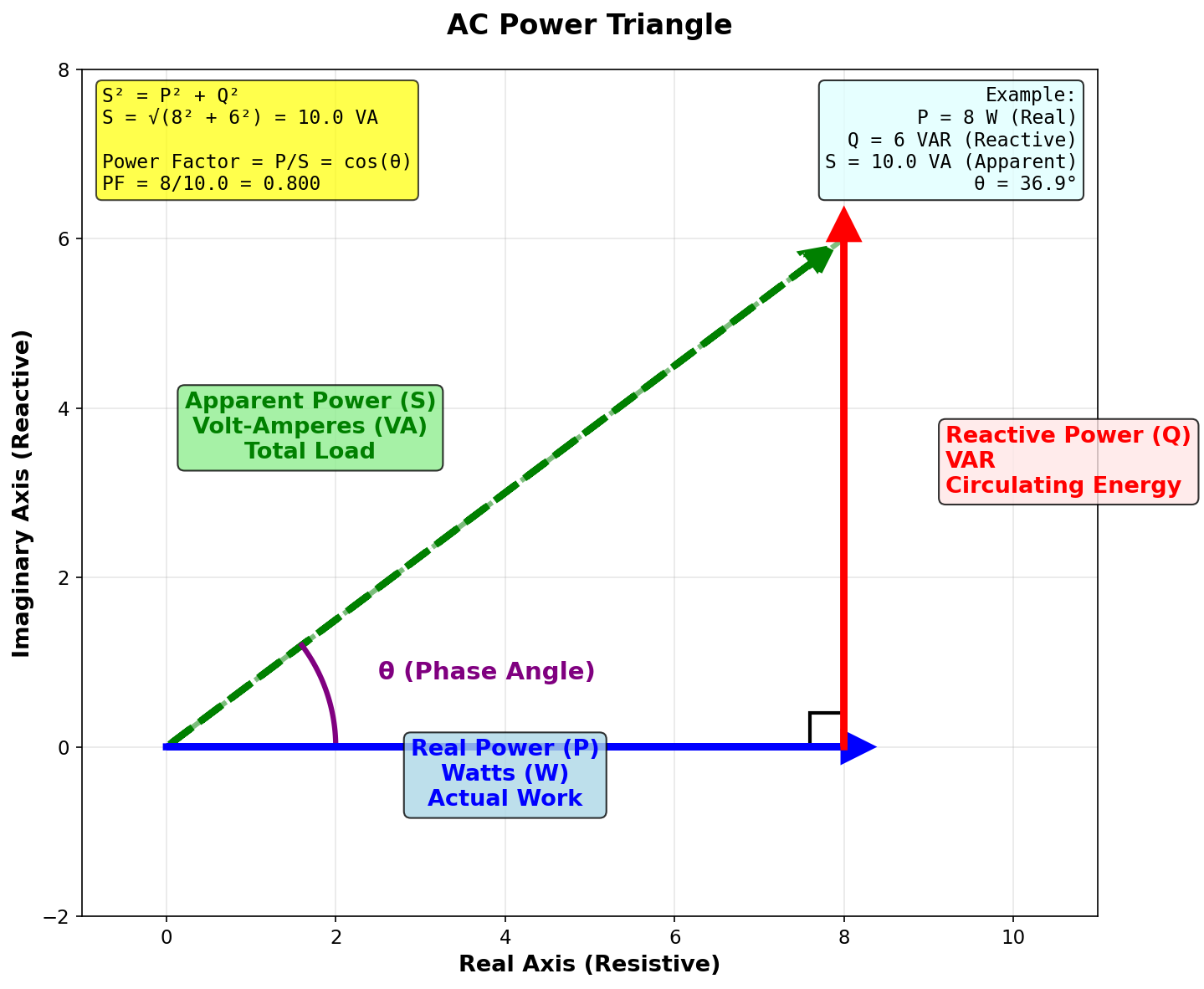
The relationship between the three powers is:
- Horizontal: Real Power (P)
- Vertical: Reactive Power (Q)
- Hypotenuse: Apparent Power (S)
- Angle: Phase angle
⚙️ Power Factor — Efficiency Indicator
Power Factor (PF) tells how efficiently power is being used.
Formula:
- PF = 1 → Perfect (purely resistive)
- PF ≈ 0 → Very inefficient (highly reactive)
| Load Type | Phase Angle | Power Factor |
|---|---|---|
| Heater | 1.0 | |
| Motor (no correction) | 0.5 | |
| Motor (corrected) | 0.94 |
🏭 Real-World Impact
- Your electricity bill charges for real power (W)
- Transmission lines carry apparent power (VA)
- Reactive power wastes infrastructure capacity
This is why industries install capacitor banks to improve power factor and reduce penalties.
🚀 Key Takeaway
- AC power splits into Real (P), Reactive (Q), and Apparent (S)
- Phase angle is the reason AC power is complex
- Power factor correction saves money, energy, and equipment life
- Always size cables, transformers, and generators using VA, not W alone
Final Insight:
⚡ AC power isn’t just about volts and amps — phase angle changes everything.