Kirchhoff's Current and Voltage Laws (KCL, KVL)
The Foundation for Circuit Analysis
These two laws are the foundation for circuit analysis. They help you solve circuits with multiple loops and junctions where simple Ohm's Law isn't enough.
Kirchhoff's Laws are conservation principles:
- KCL - Current is conserved (what goes in must come out)
- KVL - Energy is conserved (what goes up must come down)
Together, they let you analyze any circuit, no matter how complex!
🌊 Kirchhoff's Current Law (KCL)
The Law
"The total current flowing into a node must equal the total current flowing out."
In other words: Current is conserved. No current mysteriously disappears or appears.
A node (or junction) is any point where two or more wires connect.
Understanding KCL
Think of a highway intersection:
- Cars entering the intersection = current flowing in
- Cars leaving the intersection = current flowing out
- No cars disappear or appear inside the intersection
- Cars in = Cars out
Same principle applies to electrical current!
The Mathematical Expression
Or equivalently:
Where currents flowing into the node are positive, and currents flowing out are negative.
KCL Example
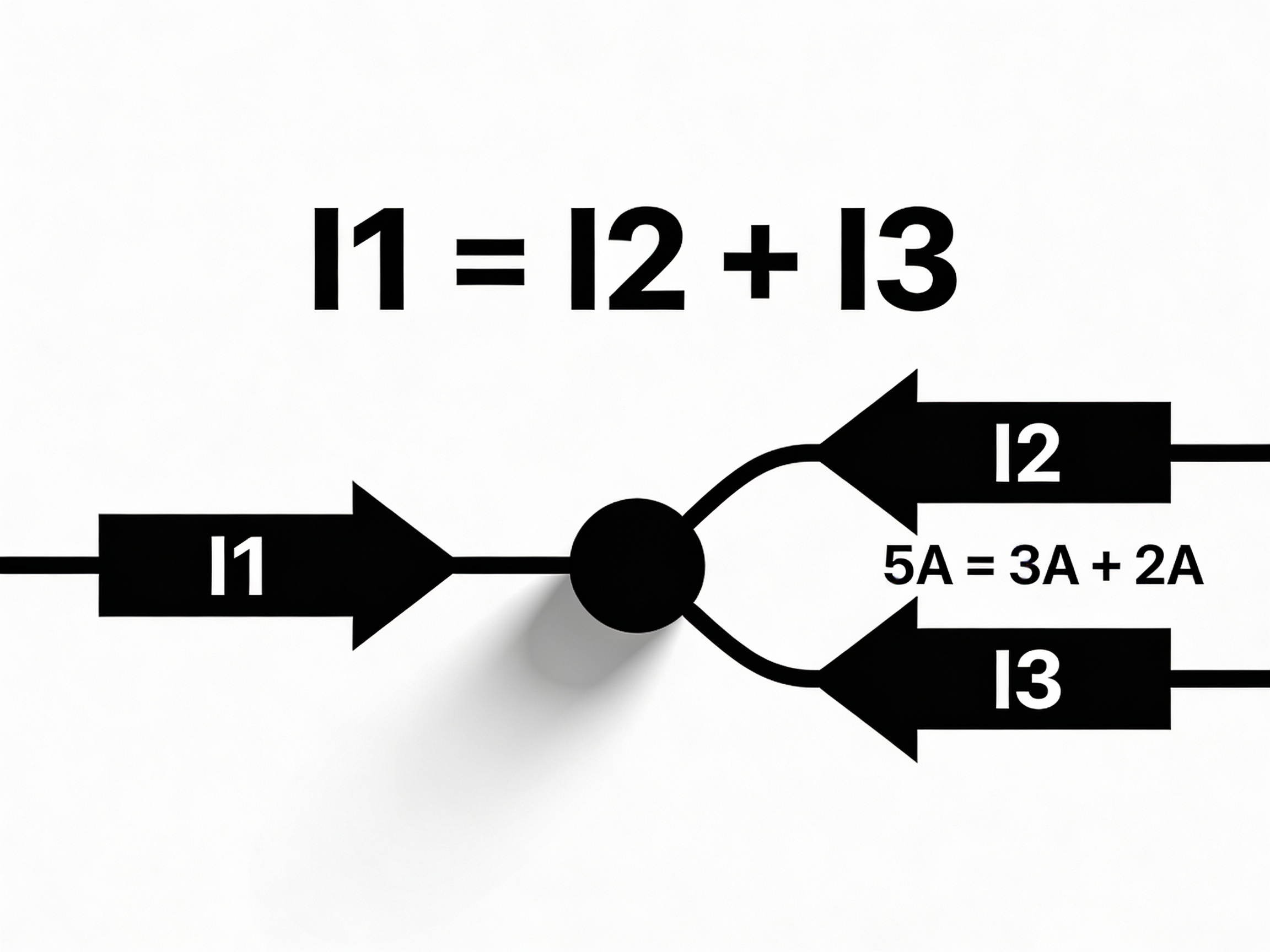
At a node where 3 wires meet:
Given:
- 5A flows in from the left
- 2A flows out the top
Question: How much current flows out to the right?
Solution:
Current IN = Current OUT
5A = 2A + I_right
I_right = 5A - 2A
I_right = 3A
Answer: 3A must flow out to the right!
Multiple Current Example
| Wire | Direction | Current |
|---|---|---|
| Wire 1 | IN | 10A |
| Wire 2 | OUT | 4A |
| Wire 3 | OUT | 3A |
| Wire 4 | OUT | ? |
10A (in) = 4A + 3A + I4 (out)
I4 = 10A - 7A = 3A
⚡ Kirchhoff's Voltage Law (KVL)
The Law
"The sum of all voltages around a closed loop equals zero."
In other words: What goes up must come down. If you gain voltage from a battery, you must lose it through resistors.
Energy is conserved - you can't create or destroy voltage in a loop!
Understanding KVL
Think of hiking around a mountain loop:
- You climb up (gain altitude) = battery provides voltage
- You walk down (lose altitude) = resistors drop voltage
- When you return to start = net altitude change is zero
Same principle applies to voltage in a circuit loop!
The Mathematical Expression
Where:
- Voltage rises (batteries) are positive
- Voltage drops (resistors) are negative
KVL Example
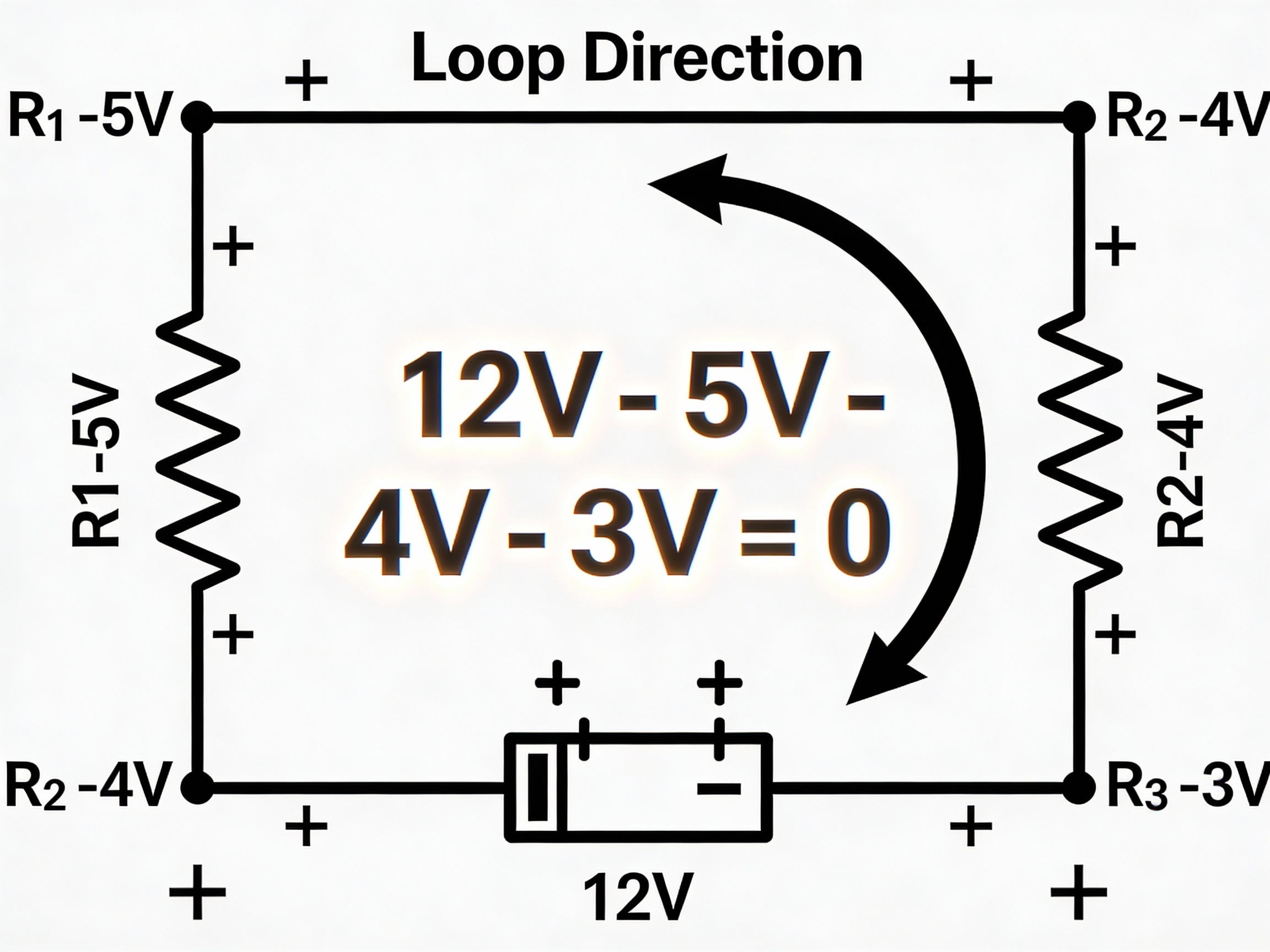
In a loop with:
Given:
- +12V battery (voltage gain)
- -5V across resistor 1 (voltage loss)
- -4V across resistor 2 (voltage loss)
- -3V across resistor 3 (voltage loss)
Checking KVL:
Sum of all voltages = 0
+12V - 5V - 4V - 3V = 0
12V - 12V = 0 ✓
Result: The law is satisfied! Energy is conserved.
Finding Unknown Voltage
| Component | Voltage | Type |
|---|---|---|
| Battery | +9V | Rise |
| Resistor 1 | -3V | Drop |
| Resistor 2 | -2V | Drop |
| Resistor 3 | ? | Drop |
+9V - 3V - 2V - V3 = 0
V3 = 9V - 3V - 2V
V3 = 4V
🔧 Applying Kirchhoff's Laws Together
Most real circuits require both laws working together:
KCL handles current distribution at nodes
KVL handles voltage distribution around loops
Together they create a system of equations you can solve!
Step-by-Step Circuit Analysis
- Identify all nodes → Apply KCL at each node
- Identify all loops → Apply KVL around each loop
- Create equations → One equation per node/loop
- Solve simultaneously → Find unknown currents and voltages
💡 Why These Laws Matter
Kirchhoff's Laws enable you to:
- ✅ Analyze multi-loop circuits (solar panels in series-parallel)
- ✅ Find unknown currents in complex networks
- ✅ Validate circuit designs before building
- ✅ Troubleshoot faulty circuits by checking conservation
- ✅ Foundation for advanced techniques:
- Mesh analysis
- Nodal analysis
- Thevenin/Norton theorems
Real-World Applications
| Application | Which Law | Why |
|---|---|---|
| Power distribution | KCL | Current splits at junctions |
| Battery bank analysis | KVL | Voltages add in series |
| LED array design | Both | Current distribution + voltage drops |
| Solar panel arrays | Both | Series-parallel combinations |
| Complex PCB circuits | Both | Multiple paths and loops |
📊 Quick Reference Summary
KCL (Current Law)
| Property | Description |
|---|---|
| Applies to | Nodes (junctions) |
| Conservation of | Current (charge) |
| Formula | Σ I_in = Σ I_out |
| Key idea | Current in = Current out |
| Analogy | Cars at intersection |
KVL (Voltage Law)
| Property | Description |
|---|---|
| Applies to | Closed loops |
| Conservation of | Energy (voltage) |
| Formula | Σ V = 0 |
| Key idea | Voltage rises = Voltage drops |
| Analogy | Hiking around mountain |
🎯 Practice Tips
For KCL:
- Pick a direction convention (in = positive, out = negative)
- Label all currents at the node
- Write equation: sum of all currents = 0
- Solve for unknown
For KVL:
- Pick a loop direction (clockwise or counterclockwise)
- Walk around the loop, noting voltage rises (+) and drops (-)
- Write equation: sum of all voltages = 0
- Solve for unknown
Pro tip: Draw arrows on your circuit diagram to show current direction and loop direction!
Common Mistakes to Avoid
❌ Forgetting signs - Pay attention to + and - directions
❌ Missing currents - Count all wires at a node
❌ Incomplete loops - Make sure loop returns to starting point
❌ Mixing up laws - KCL for nodes, KVL for loops
✅ Always check: Do currents balance? Do voltages sum to zero?
🚀 Advanced Applications
These laws form the basis for:
| Technique | Uses KCL/KVL | Purpose |
|---|---|---|
| Mesh Analysis | KVL | Systematic loop analysis |
| Nodal Analysis | KCL | Systematic node analysis |
| Superposition | Both | Multiple source analysis |
| Thevenin/Norton | Both | Circuit simplification |
| Circuit simulation | Both | Computer-aided analysis |
Kirchhoff's Laws are fundamental conservation principles:
KCL - Current Conservation:
- 🌊 Applies at nodes (junctions)
- Current in = Current out
- No current appears or disappears
- Formula: Σ I = 0
KVL - Voltage Conservation:
- ⚡ Applies around closed loops
- Voltage rises = Voltage drops
- Energy is conserved
- Formula: Σ V = 0
Together they solve any circuit:
- Start with what you know
- Apply the appropriate law
- Create and solve equations
- Verify your results
These laws never fail - if your calculations don't work, check your assumptions and signs!