Power in Electrical Circuits
How Fast is Energy Being Used?
Think of it like water flowing through a pipe. Voltage is like the pressure. Current is like the flow rate. Power is how much work the water can do per second.
Power answers the question: How fast is energy being used or delivered?
It's not just about how much voltage or current you have - it's about the combination of both working together to do useful work.
⚡ The Basic Power Formula
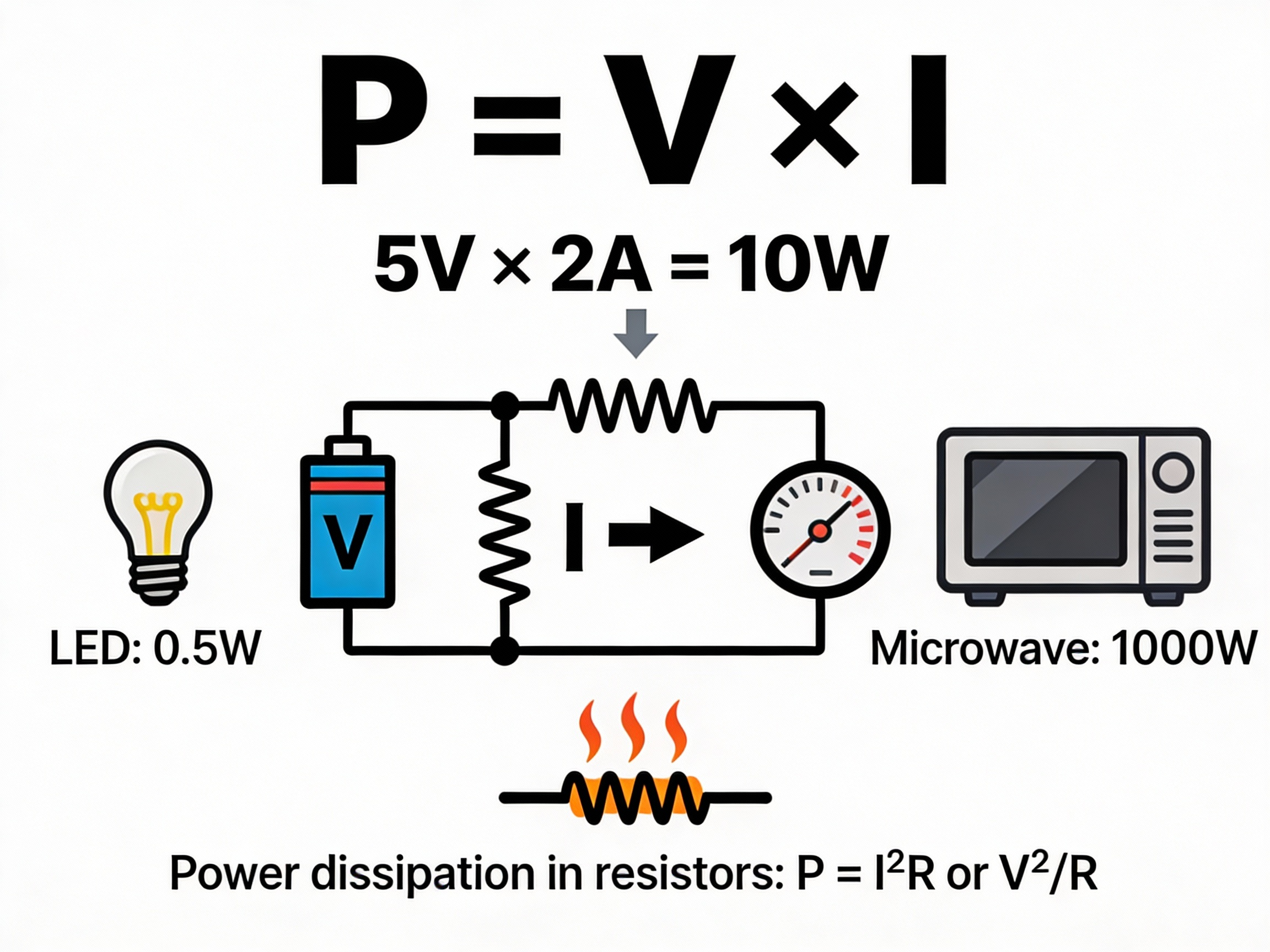
The fundamental relationship between power, voltage, and current:
Where:
- P = Power (in Watts)
- V = Voltage (in Volts)
- I = Current (in Amperes)
Power is the product of voltage and current.
- Higher voltage and higher current = more power
- Double the voltage or double the current = double the power
- Double both = quadruple the power!
💡 Practical Examples
Let's see how this works in real circuits:
| Voltage | Current | Power Calculation | Power | Typical Device |
|---|---|---|---|---|
| 5V | 2A | 5 × 2 | 10W | USB device charging |
| 12V | 1A | 12 × 1 | 12W | LED strip |
| 9V | 0.5A | 9 × 0.5 | 4.5W | Small motor |
| 3.3V | 0.1A | 3.3 × 0.1 | 0.33W | Microcontroller |
| 230V | 4.3A | 230 × 4.3 | 1000W | Microwave oven |
🔧 Why Power Matters in Circuit Design
Understanding power is critical for several reasons:
Power determines:
- 🔥 Heat generation - Components heat up when they dissipate power
- 🔋 Battery life - Higher power = faster battery drain
- 💰 Energy cost - More power = higher electricity bills
- ⚠️ Component ratings - Exceed power rating = component failure/fire
- 🛡️ Wire sizing - Higher power needs thicker wires
Real-World Scenarios
| Scenario | Why Power Matters |
|---|---|
| 5V circuit pulling 2A | Uses 10 Watts of power |
| 12V battery powering 1A device | Uses 12 Watts |
| Batteries heating up | Delivering lots of power |
| Components have power ratings | 5W resistor vs 0.25W resistor |
📐 Alternative Power Formulas (Using Ohm's Law)
We can derive alternative power formulas by combining the basic power formula with Ohm's Law (V = I × R):
Formula 1: Power from Voltage and Resistance
Use when you know: Voltage and Resistance
Example:
Formula 2: Power from Current and Resistance
Use when you know: Current and Resistance
Example:
| To find Power | Formula | Use when you know |
|---|---|---|
| Basic | Voltage and Current | |
| Voltage-based | Voltage and Resistance | |
| Current-based | Current and Resistance |
All three formulas give the same result - use whichever is most convenient!
🔋 Energy vs Power - Understanding the Difference
Many beginners confuse energy and power. Let's clarify:
Power = How fast energy is used (Watts)
Energy = Power over time (Joules or Watt-hours)
| Concept | Unit | What it measures |
|---|---|---|
| Power | Watts (W) | Rate of energy use |
| Energy | Joules (J) or Watt-hours (Wh) | Total work done |
The Formula
Where:
- Energy in Watt-hours (Wh) or Joules (J)
- Power in Watts (W)
- Time in hours (for Wh) or seconds (for J)
Practical Examples
| Device | Power | Time | Energy Used |
|---|---|---|---|
| 100W light bulb | 100W | 1 hour | 100 Watt-hours (0.1 kWh) |
| 100W light bulb | 100W | 10 hours | 1000 Watt-hours (1 kWh) |
| 60W laptop | 60W | 8 hours | 480 Watt-hours (0.48 kWh) |
| 1000W microwave | 1000W | 0.1 hour (6 min) | 100 Watt-hours (0.1 kWh) |
| 5W phone charger | 5W | 2 hours | 10 Watt-hours (0.01 kWh) |
Your electricity bill charges you for energy (kilowatt-hours, kWh), not power!
- A 100W bulb running for 10 hours uses the same energy as
- A 1000W microwave running for 1 hour
Both consume 1 kWh of energy!
📊 Power Ratings and Component Selection
Every component has a maximum power rating. Exceeding this causes:
- Overheating
- Damage
- Fire hazard
- Component failure
Common Component Power Ratings
| Component Type | Typical Power Ratings | Common Uses |
|---|---|---|
| Resistors | 1/8W, 1/4W, 1/2W, 1W, 2W, 5W, 10W | Current limiting, voltage division |
| LEDs | 0.1W - 3W | Indicators, lighting |
| Transistors | 0.5W - 100W | Amplification, switching |
| Voltage regulators | 1W - 50W | Power supply regulation |
| Motors | 1W - 1000W+ | Mechanical work |
Always leave headroom!
Good practice:
- Design for 50-70% of maximum power rating
- This accounts for temperature variations
- Extends component lifetime
- Provides safety margin
Example: If calculation shows 2W dissipation, use a 5W resistor, not a 2W!
🔥 Power Dissipation and Heat Management
When components dissipate power, they generate heat. Too much heat causes failure.
Calculating Power Dissipation
Given:
- Resistor: 100Ω
- Voltage across it: 10V
- Find power dissipation
Solution:
P = V² / R
P = 10² / 100
P = 100 / 100
P = 1W
Component selection: Use a 2W or higher resistor for safety!
Heat Management Strategies
| Power Level | Cooling Strategy | Examples |
|---|---|---|
| < 1W | No special cooling | Standard resistors, ICs |
| 1W - 5W | Larger component, air flow | Power resistors, regulators |
| 5W - 20W | Heat sink | Power transistors, voltage regulators |
| 20W+ | Heat sink + fan | Motor drivers, power supplies |
| 100W+ | Large heat sink + forced air | Power amplifiers, inverters |
💰 Calculating Energy Costs
Understanding power helps you calculate operating costs:
Cost Calculation Formula
Device: 100W light bulb
Usage: 5 hours per day for 30 days = 150 hours/month
Electricity rate: $0.12 per kWh
Calculation:
Power = 100W = 0.1 kW
Energy = 0.1 kW × 150 hours = 15 kWh
Cost = 15 kWh × $0.12 = $1.80 per month
Switching to 20W LED:
Power = 20W = 0.02 kW
Energy = 0.02 kW × 150 hours = 3 kWh
Cost = 3 kWh × $0.12 = $0.36 per month
Savings = $1.80 - $0.36 = $1.44 per month ($17.28 per year)
📊 Quick Reference Summary
| Formula | Use Case | Example |
|---|---|---|
| Know voltage and current | 12V, 2A → 24W | |
| Know voltage and resistance | 10V, 100Ω → 1W | |
| Know current and resistance | 0.5A, 10Ω → 2.5W | |
| Calculate energy consumed | 100W × 10h → 1kWh |
Power is the combination of voltage and current working together.
Key takeaways:
- ⚡ Power = Voltage × Current (P = V × I)
- 🔥 Power dissipation generates heat
- 🔋 Energy = Power × Time (measured in Watt-hours)
- 🛡️ Always use components rated well above calculated power
- 💰 Power consumption affects battery life and energy costs
- 📐 Three equivalent formulas - use whichever is convenient
Understanding power is essential for:
- Safe circuit design
- Component selection
- Battery life estimation
- Cost calculations
- Heat management
Master power calculations - they're fundamental to all electrical work!