Fundamentals of Electric System
The Electric World - Understanding Atoms, Electrons, and How Electricity Really Works
Imagine you're standing in front of a light switch. When you flip it, the bulb lights up instantly. But have you ever wondered what's actually happening inside those wires? What's flowing? What makes it work? Today, we're going to answer these questions by starting with the very basics - the building blocks of everything around us.
What is Electricity Really?
Electricity is not magic. Electricity is not some mysterious energy that floats through wires.
Electricity is the organized, controlled movement of tiny particles called electrons.
This is the most important concept you need to understand. Everything else in electronics is just variations on this one idea.
Everything is Made of Atoms
Let's start really small. Everything around you - your phone, this computer screen, your chair, even the air you breathe - is made of atoms. Atoms are the smallest building blocks of matter. They're so incredibly tiny that you could fit billions of them on the tip of a pencil.
Inside each atom is a fascinating structure:
- Nucleus (center) - like a sun
- Protons - positive electrical charge (+)
- Neutrons - neutral, no charge
- Electrons (orbiting) - like planets around the sun
- Negative electrical charge (−)
- Much lighter than protons
- Loosely bound to the nucleus
Electrons are the interesting particles for us. They orbit around the nucleus and have a negative electrical charge. The outer electrons can be made to break free and move from atom to atom. This ability is what makes electricity possible.
Why Electrons Stay in Atoms (And Why They Sometimes Leave)
You might be wondering: if electrons have negative charge and protons have positive charge, why don't electrons just fall into the nucleus?
The answer is electrostatic attraction - the negative electrons are attracted to the positive protons, and this pull keeps them orbiting at a certain distance, like gravity keeps Earth orbiting the sun.
But here's the interesting part: not all electrons are held equally tightly.
| Electron Type | Binding Strength | Behavior |
|---|---|---|
| Inner electrons | Very tightly bound | Difficult to remove |
| Outer electrons (valence) | Loosely bound | Can easily leave the atom |
The outer electrons are called "free electrons" or "valence electrons" because they can pretty easily be made to leave the atom.
When we apply energy (chemical, heat, light, or mechanical), we can knock these outer electrons loose. When enough electrons are knocked loose and start moving from atom to atom, we call that electric current.
Three Types of Materials
Not all materials let electrons move equally easily. Understanding conductors, insulators, and semiconductors is crucial.
⚡ Conductors
Materials where outer electrons are very loosely bound - easy to free up.
- Examples: Copper, aluminum, silver
- Why copper wires? Electrons in copper move very easily
- When you push energy into copper, electrons flow freely
🛡️ Insulators
Materials where electrons are held very tightly - difficult to move.
- Examples: Rubber, plastic, glass, wood
- Why wrap wires in rubber? Prevents electrons from flowing where we don't want them
- Insulators protect us from electric shock
🔷 Semiconductors
The clever middle ground - can be controlled to conduct or insulate.
- Examples: Silicon, germanium
- Special property: Can be treated to sometimes conduct, sometimes not
- By controlling with a small electrical signal, we can turn electron flow on and off
- Foundation of modern electronics: Transistors, diodes, computer chips
All computer chips use semiconductors! Your phone's processor has billions of tiny semiconductor switches turning on and off millions of times per second.
What is Electric Current?
Now we can define electric current properly:
Electric Current = The flow of electrons through a material
When electrons move from one atom to another, one after another, in a continuous stream, that's current.
Unit of measurement: Amperes (Amps, abbreviated A)
- Example:
2Ameans 2 Amperes of current is flowing
Electrons can only flow if there's a complete, unbroken path.
Think of a highway - cars can only flow smoothly if the road is complete. If there's a bridge out, traffic stops. Same with electrons!
- Open circuit: Break in the path → electrons stop flowing
- Closed circuit: Complete path → electrons flow continuously
The Confusing Thing About Current Direction
Here's something that might seem strange, but it's important to know:
Physical reality: Electrons flow from negative (−) → positive (+)
Convention in diagrams: Current flows from positive (+) → negative (−)
Why the difference? When scientists first invented electricity, they didn't know about electrons. They made a guess about which direction current flowed, and they guessed wrong. By the time we discovered electrons, everyone had already drawn all their diagrams and formulas using the "wrong" direction.
Don't let this confuse you - both descriptions are describing the same physical phenomenon. Just remember:
- Electrons move: − to +
- Current drawn: + to −
A Water Analogy That Actually Makes Sense
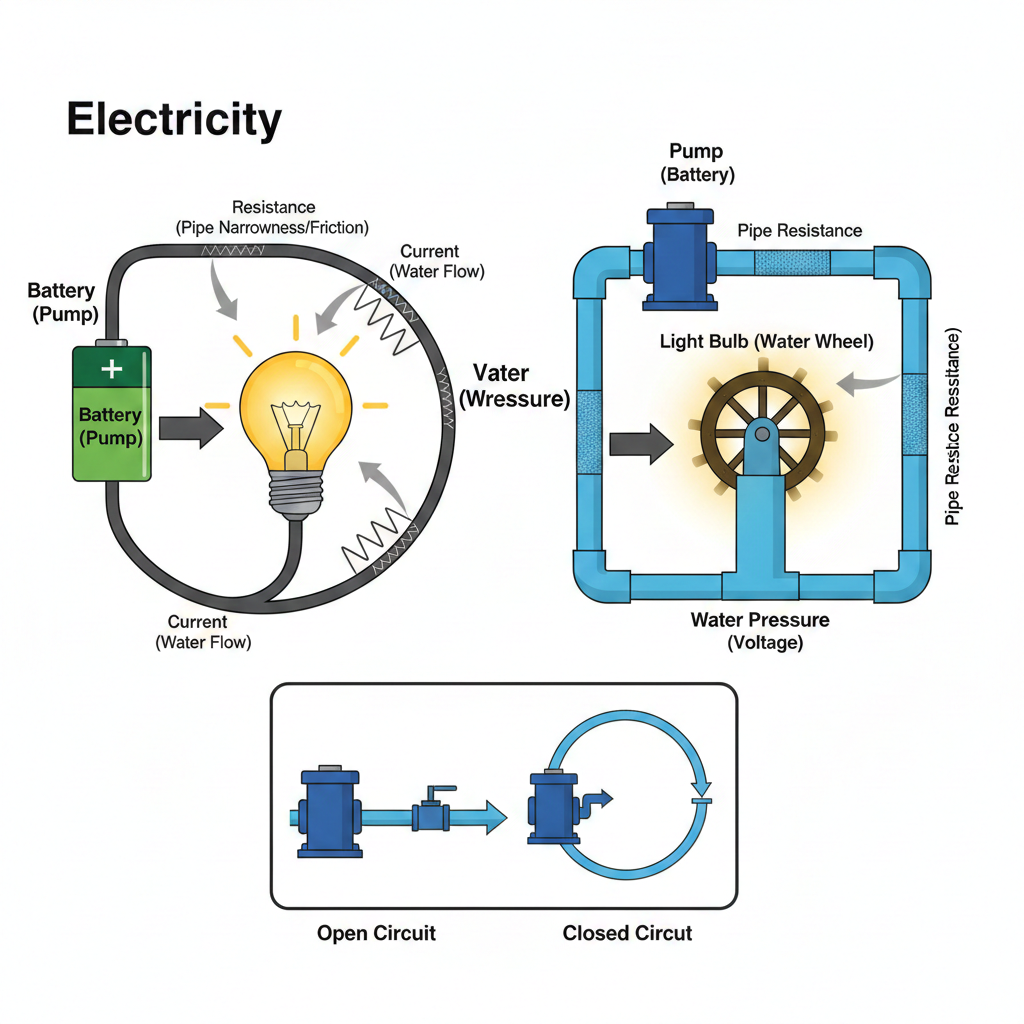
Let me give you an analogy that might help cement this in your mind. Think of electricity like water flowing through pipes:
| Water System | Electrical System |
|---|---|
| Water pressure | Voltage - the push |
| Flow rate | Current - how much is moving |
| Pipe resistance (friction) | Electrical resistance - opposes flow |
| Pump | Battery - creates the pressure |
Open vs Closed Circuit Analogy
Open Circuit (valve closed):
- Pipe connected to pump, but valve is closed
- No water flows, even though pump is pushing
- Same with electricity: no current flows even though battery is pushing
Closed Circuit (valve open):
- Complete loop: pump → pipe → faucet → back to pump
- Water flows smoothly
- Same with electricity: battery → wire → bulb → back to battery
- Electrons flow and light turns on ✓
Why This Matters
Understanding that electricity is just moving electrons is absolutely critical because it explains everything that comes next.
Every component in electronics works by controlling and directing the flow of electrons:
- 🔧 Resistors - control electron flow
- ⚡ Capacitors - store electrons temporarily
- 🔀 Transistors - switch electron flow on/off
- 💾 Microchips - millions of tiny electron switches
Once you understand that electricity is organized electron flow, and that this flow needs a complete circuit, you're ready to start learning about voltage, current, and resistance.
Electricity is not mysterious or magical. It's a perfectly logical phenomenon based on the properties of atoms and electrons.
In the next lesson, we're going to talk about the fundamental quantities we use to measure and control this electron flow.