🔋 Capacitors in Real Life — Practical Aspects and Specifications
A real capacitor is not an ideal component — it comes with limits, imperfections, and real-world behavior.
Choosing the right capacitor is just as important as understanding capacitance itself.
The wrong choice can mean instability, overheating, or outright failure.
⚡ Thinking of Capacitors in the Real World
A practical way to think of a capacitor is like a battery with rules:
- It stores energy
- It has a maximum safe voltage
- It leaks slowly over time
- It behaves differently at high frequency and temperature
Unlike ideal capacitors from textbooks, real capacitors change behavior depending on conditions.
🔥 Voltage Rating — Safety Comes First
Every capacitor has a maximum voltage rating, printed as 25V, 50V, 100V, etc.
If the applied voltage exceeds this rating:
- The dielectric can break down
- The capacitor may heat up
- Electrolytic capacitors can burst or explode
👉 Rule of thumb:
Always choose a voltage rating at least 1.5× to 2× higher than the maximum circuit voltage.
| Circuit Voltage | Minimum Safe Capacitor Rating |
|---|---|
| 12 V | 25 V |
| 24 V | 50 V |
| 48 V | 100 V |
🧺 Capacitance Value — How Much Can It Store?
Capacitance tells how much charge a capacitor can store per volt.
Unit: Farad (F)
Practical units:
- (microfarads)
- (nanofarads)
- (picofarads)
The stored charge is:
Bigger capacitance = more energy storage, but usually larger physical size.
🎯 Tolerance — Capacitors Are Never Exact
A capacitor marked 100 μF is not exactly 100 μF.
Typical tolerances:
- ±5%
- ±10%
- ±20%
This means:
Tolerance matters greatly in:
- Timing circuits
- Filters
- Oscillators
| Rated Value | Tolerance | Actual Range |
|---|---|---|
| 100 μF | ±20% | 80 μF – 120 μF |
| 10 nF | ±5% | 9.5 nF – 10.5 nF |
🌡️ Temperature & Frequency Effects — The Hidden Variables
Capacitance changes with temperature and frequency.
- High temperatures can reduce lifespan
- High frequencies expose losses and ESR
- Some dielectrics are more stable than others
Material stability (best → worst):
- Film
- Ceramic (C0G / NP0)
- Electrolytic
Never assume a capacitor behaves the same at:
- 25°C vs 70°C
- 50 Hz vs 100 kHz
💧 Leakage Current — The Silent Discharge
Real capacitors slowly leak charge internally, even when disconnected.
Leakage current:
- Is very small
- Increases with temperature
- Is highest in electrolytic capacitors
This matters in:
- Timing circuits
- Backup power
- Sample-and-hold circuits
| Capacitor Type | Leakage |
|---|---|
| Electrolytic | High |
| Film | Low |
| Ceramic | Very Low |
📦 Physical Size & Form Factor
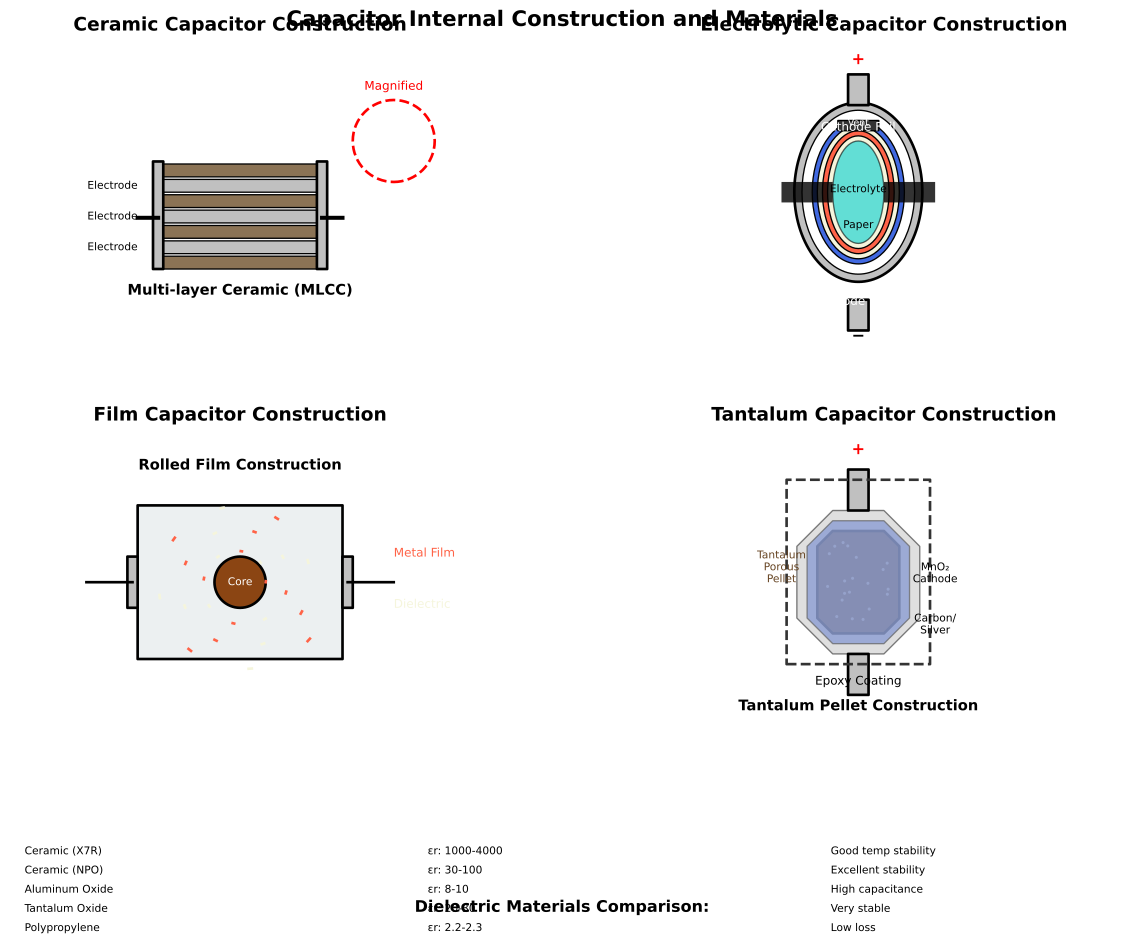
Capacitors come in many packages:
- Disc
- Cylindrical
- Radial / Axial
- Surface Mount (SMD)
Physical size depends on:
- Capacitance
- Voltage rating
- ESR
- Current handling
Higher current → larger capacitor required.
🔥 ESR — Equivalent Series Resistance
Every real capacitor has an internal resistance called ESR.
Effects of high ESR:
- Power loss
- Heat generation
- Reduced efficiency
- Poor high-frequency performance
Power loss due to ESR:
This is critical in:
- SMPS
- Inverters
- Audio amplifiers
High ESR capacitors in power supplies can:
- Overheat
- Dry out
- Fail prematurely
🧠 Choosing the Right Capacitor — Practical Checklist
| Question | What to Check |
|---|---|
| Voltage | Rating > max circuit voltage |
| Capacitance | Required by circuit |
| Stability | Tolerance & dielectric |
| Frequency | ESR & frequency rating |
| Temperature | Operating range |
| Leakage | Critical for timing/storage |
| Size | PCB & mechanical limits |
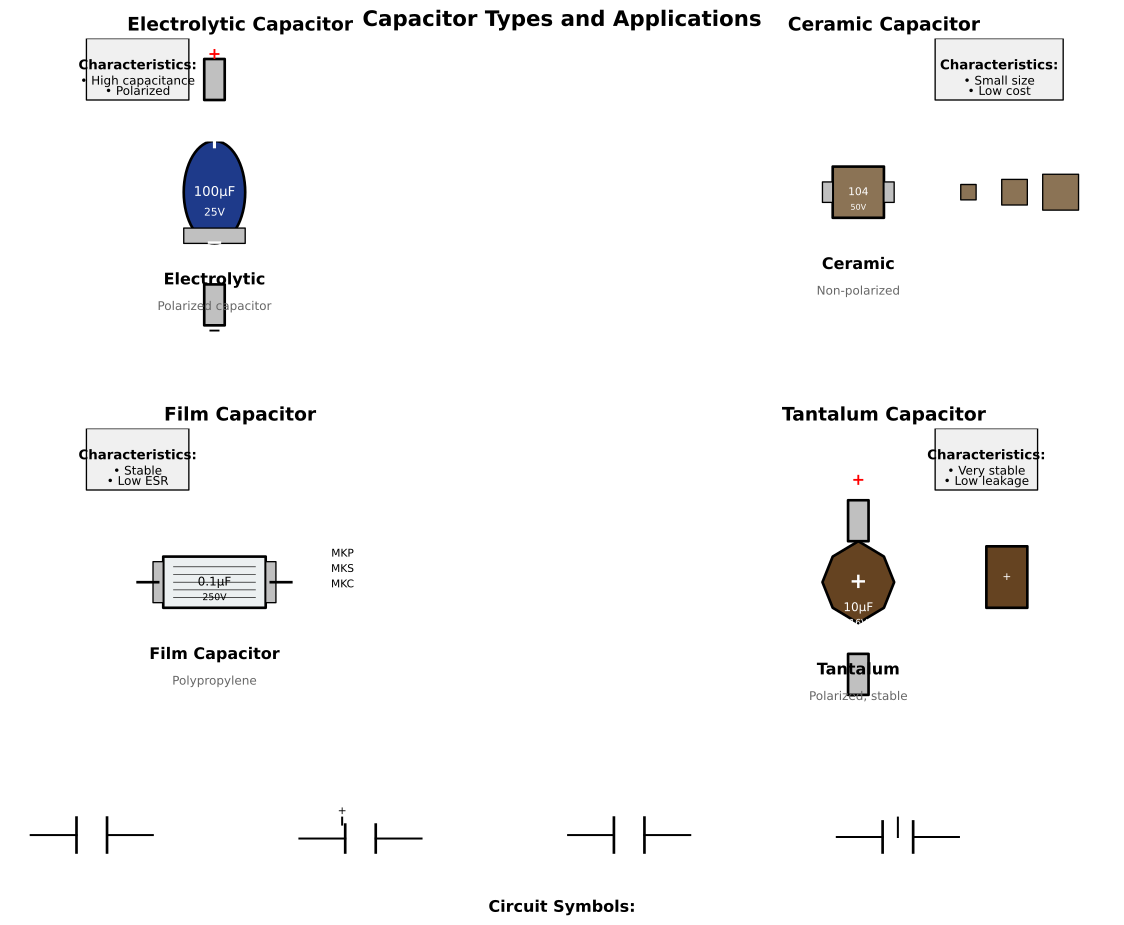
🧩 Capacitor Types in Practice
Electrolytic
- Large capacitance
- Cheap
- High leakage, polarized
Film
- Stable
- Accurate
- Long life
Ceramic
- Very small
- Excellent for high frequency
- Lower capacitance stability (except NP0)
Mica / Paper
- Extremely stable
- Used in precision & RF
🚀 Key Takeaway
- Capacitors have limits, losses, and imperfections
- Voltage rating is about safety
- ESR and leakage decide reliability
- Capacitor choice separates temporary designs from professional designs
- Always design for real-world conditions, not ideal theory
Final Insight:
🔋 A capacitor isn’t just a value — it’s a behavior.