🔬 Understanding Semiconductors — The Building Blocks of Modern Electronics
If copper wires are open pipes for electricity, semiconductors are smart gates that can open, close, or partially open on command.
They sit perfectly between conductors and insulators — and most importantly, their conductivity can be controlled.
This single property powers all modern electronics.
🧠 What Makes a Semiconductor Special?
Semiconductors are usually made from silicon or germanium.
- Pure silicon conducts very poorly
- Adding tiny amounts of impurities (doping) changes everything
Two types of doping:
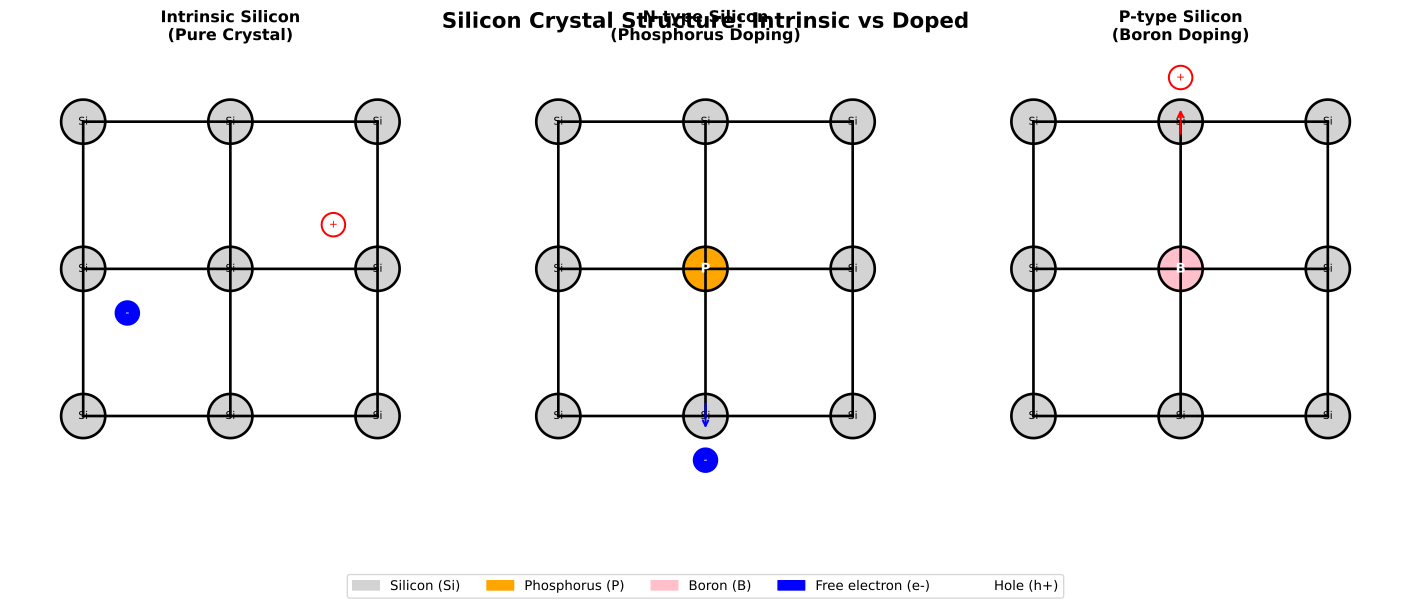
- N-type: Add atoms with extra electrons (e.g. phosphorus)
- P-type: Add atoms missing electrons, creating holes (e.g. boron)
This creates a material where current flow is controllable, not fixed.
Intrinsic vs Doped Silicon
🔧 BJT Transistor Structure
NPN BJT Cross-Section

NPN vs PNP Comparison

⚡ MOSFET Structure and Types
MOSFET Cross-Section

NMOS vs PMOS Symbols

🔧 Special Diode Types
Schottky Diode Cross-Section

Schottky vs Conventional Diode I-V Comparison

Zener Diode Cross-Section

Zener I-V Characteristics

⚡ Silicon Controlled Rectifier (SCR)
SCR Cross-Section Structure

SCR Two-Transistor Model

SCR I-V Characteristics

🔧 Photodiode Operation
Photodiode Structure

Photodiode Circuit Configurations

📊 Transistor Operating Regions
BJT Operating Regions

🔥 Thermal Management
Thermal Equivalent Circuit

🔧 Practical Circuits
BJT Switch Circuit

Zener Voltage Regulator

SCR Crowbar Protection

➡️ The Diode — The Simplest Semiconductor Device
A diode is formed by joining P-type and N-type materials.
At the junction:
- Forward bias → current flows
- Reverse bias → current is blocked
This makes a diode a one-way valve for electricity.
Common uses:
- AC to DC rectification
- Signal detection
- Reverse-polarity protection
| Bias Direction | Current Flow |
|---|---|
| Forward Bias | ✅ Yes |
| Reverse Bias | ❌ No |
⚠️ Forward Voltage Drop — Why Diodes Aren’t Ideal
Real diodes are not perfect switches.
A silicon diode has a typical forward voltage drop:
This means:
- Below → little conduction
- Above → current flows
- is lost as heat
For low-voltage circuits, this loss matters.
| Diode Type | Forward Voltage |
|---|---|
| Silicon | ~0.7 V |
| Schottky | ~0.3 V |
| Germanium | ~0.3 V |
🔁 The Transistor — The Revolutionary Device
A transistor uses one signal to control another.
Two main families:
- BJT (Bipolar Junction Transistor) — current-controlled
- FET (Field Effect Transistor) — voltage-controlled
BJT behavior:
A small base current controls a large collector current.
Gain:
Typical values: 100–300
| Base Current | Gain | Collector Current |
|---|---|---|
| 1 mA | 200 | 200 mA |
⚡ FETs — Control with Voltage
A FET controls current using an electric field, not current.
- Gate draws almost zero current
- Excellent for low-power and high-speed circuits
This is why MOSFETs dominate modern electronics — from microcontrollers to power supplies.
🔥 Power Dissipation — The Heat Problem
Whenever current flows through a semiconductor, heat is generated.
Power dissipation:
- Switching mode → low heat
- Linear mode → high heat
Excess heat damages devices, so thermal design is critical.
Without proper heat sinking:
- Junction temperature rises
- Device parameters drift
- Permanent failure occurs
🎛️ Operational Amplifiers — Transistors in Disguise
An op-amp is a complete amplifier built from many transistors.
Typical open-loop gain:
By adding feedback, one IC can become:
- Amplifier
- Comparator
- Integrator
- Differentiator
Op-amps allow complex behavior with simple external components.
🌡️ Temperature Sensitivity — The Environmental Challenge
Semiconductors are temperature-sensitive.
Effects of rising temperature:
- Increased current
- Reduced bandgap voltage
- Increased leakage
This can lead to thermal runaway.
Maximum junction temperatures:
- Typical: to
🌫️ Leakage Current — The Silent Background Effect
Even when “off,” semiconductor devices leak a small current.
Leakage current:
- Increases exponentially with temperature
- Is usually negligible at room temperature
- Becomes critical in precision circuits
⚡ Breakdown Voltage — The Absolute Limit
Every semiconductor has a maximum voltage limit.
Exceeding it causes:
- Avalanche conduction
- Excessive heating
- Permanent damage
Always design below rated breakdown voltage.
| Device | Breakdown Voltage |
|---|---|
| Small diode | ~100 V |
| 1N4007 | 1000 V |
| Power transistor | 30–600 V |
🚀 Key Takeaway
- Semiconductors allow controlled conductivity
- Diodes are one-way devices
- Transistors enable amplification and switching
- Temperature, voltage, and power limits matter
- Modern electronics exists because semiconductors are controllable
Final Insight:
🔬 Semiconductors turn raw electricity into intelligence.