🎚️ Introduction to Amplifiers
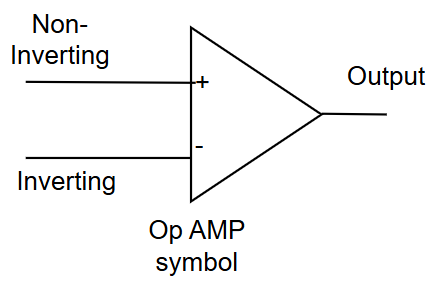
An amplifier is one of the most important building blocks in electronics.
Imagine a whisper that needs to be heard in a large stadium — an amplifier takes that weak whisper and makes it strong without changing its shape, only its size.
🔍 What Does an Amplifier Do?
In simple terms, an amplifier takes a weak input signal and produces a stronger output signal.
The relationship between input and output is called gain.
Example:
If:
- Input =
- Output =
Then:
This same gain expressed in decibels (dB):
So:
- Gain = 10 →
- Gain = 100 →
Higher dB means more amplification.
🎤 Real-Life Example
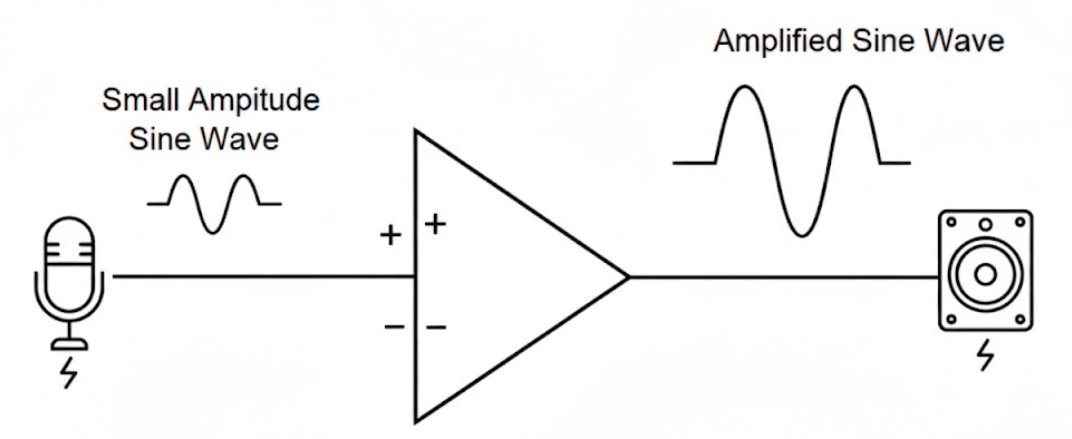
A microphone produces only a few millivolts when you speak.
That signal is far too weak to drive a speaker.
An amplifier boosts that tiny signal so the speaker can produce loud sound — same waveform, bigger size.
🌍 Amplifiers Are Everywhere
- Mobile phone speakers
- Audio systems
- ECG machines (heart signals are microvolts!)
- Security sensors
- Wireless communication receivers
- Sensor signal conditioning in embedded systems
Without amplifiers, most electronic signals would be too weak to use.
🔁 Types of Amplifiers
🔹 Voltage Amplifier
- Increases voltage
- Example:
🔹 Current Amplifier
- Increases current
- Example:
🔹 Power Amplifier
- Increases both voltage and current
- Delivers real power
- Used for:
- Speakers
- Motors
- Actuators
🎵 Frequency Response
Amplifiers are designed for specific frequency ranges.
- Audio amplifier:
- Radio amplifier: or range
Using the wrong amplifier = poor performance or distortion.
⚙️ Important Amplifier Characteristics
🔹 Linearity
A good amplifier is linear:
- Input waveform shape = Output waveform shape
- Only amplitude increases
Non-linear amplifiers cause distortion.
🔹 Bandwidth
The frequency range the amplifier can handle effectively.
Wider bandwidth = supports more frequencies.
🔹 Input & Output Impedance
- High input impedance → does not load the signal source
- Low output impedance → can drive next stage easily
This ensures efficient signal transfer.
🔹 Noise
All amplifiers add noise.
If the signal is very small, noise can become dominant.
Low-noise amplifiers are critical for:
- Sensors
- Audio
- RF systems
🔹 Slew Rate
How fast the output voltage can change:
If the signal changes faster than the slew rate, distortion occurs.
🧪 Simple Practical Example
A light sensor outputs:
Too small for an ADC to read reliably.
Use an amplifier with gain = 100:
Now the signal is easy to measure and process.
🚀 Why Amplifiers Matter
Sensors, antennas, microphones, and pickups all produce weak signals.
Amplifiers:
- Make signals usable
- Preserve signal shape
- Enable accurate measurement and control
✅ The Bottom Line
- Amplifiers boost signals
- They increase voltage, current, or power
- They keep the signal shape intact
- Without amplifiers, modern electronics would not exist
Understanding amplifiers is fundamental to electronics, embedded systems, signal processing, and communication systems.