🧲 Inductors in Real Life — Practical Design and Selection
If capacitors resist changes in voltage, inductors resist changes in current.
They store energy in a magnetic field, not an electric field, and this makes them indispensable in power supplies, filters, and RF circuits.
Choosing the wrong inductor can cause overheating, noise, or total circuit failure.
🔄 What Is an Inductor, Really?
An inductor is simply a coil of wire. When current flows through it, a magnetic field is created around the coil.
The key behavior:
- Inductors oppose changes in current
- Faster current change → stronger opposition
This opposition is called inductive reactance, and it depends on frequency.
Unit: Henry (H)
Common values:
- $$\mu H$$ (microhenry)
- $$mH$$ (millihenry)
Inductive reactance:
$$
X_L = 2\pi f L
$$
Where:
- $$f$$ = frequency (Hz)
- $$L$$ = inductance (H)
📐 Inductance Value — How Strong Is the Effect?
The inductance value determines how strongly an inductor resists current change.
- Small $$L$$ → weak opposition
- Large $$L$$ → strong opposition
Inductance depends on:
- Number of turns
- Coil geometry
- Core material
Like capacitors, inductors come in standard values, chosen during circuit design.
🧱 Core Material — The Heart of the Inductor
Unlike capacitors, inductors rely heavily on core material.
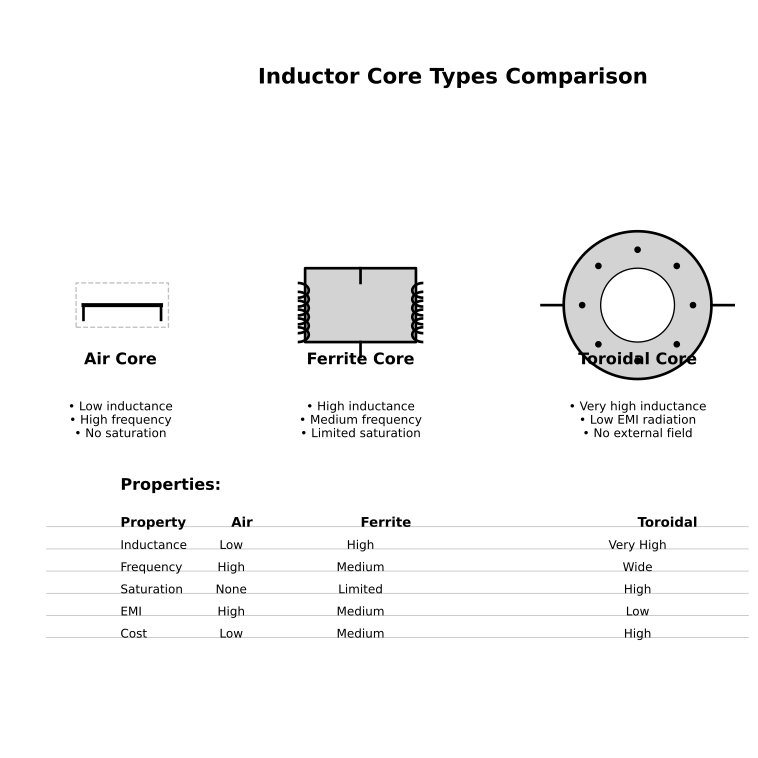
Core Types and Behavior
| Core Type | Key Properties | Typical Use |
|---|---|---|
| Air Core | No saturation, low inductance | RF, high-frequency |
| Iron Core | High inductance, saturates easily | Low-frequency |
| Ferrite Core | Good inductance, low losses | SMPS, filters |
| Toroidal Core | Low EMI, efficient | Sensitive circuits |
Ferrite cores dominate modern power electronics due to their efficiency at high frequencies.
🔥 Resistance and Losses — Why Inductors Heat Up
Real inductors are not lossless.
Main loss mechanisms:
- DC Resistance (DCR) — wire resistance
- Skin effect — current crowds outer conductor at high frequency
- Core losses — hysteresis and eddy currents
Copper loss:
$$
P_{copper} = I^2 \times R
$$
Core loss increases rapidly with frequency and flux density.
High losses lead to:
- Excessive heating
- Reduced efficiency
- Shortened component life
🚨 Saturation Current — The Breaking Point
Magnetic cores have a saturation limit.
When current exceeds the saturation current:
- Inductance collapses
- Current spikes
- Heat rises rapidly
This is a common cause of SMPS failure.
👉 Always select:
$$
I_{sat} \ge 1.5 \times I_{max}
$$
| Circuit Current | Minimum Inductor Rating |
|---|---|
| 2 A | ≥ 3 A |
| 5 A | ≥ 7.5 A |
📡 Frequency Response — Why Inductors Are Filters
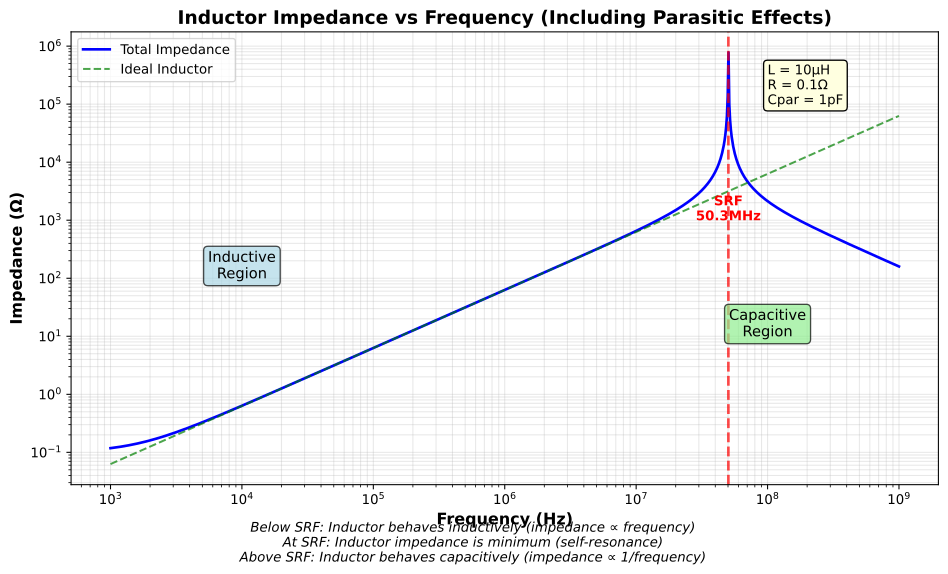
Inductor impedance increases with frequency:
- Low frequency → almost short circuit
- High frequency → blocks current
This makes inductors perfect for:
- Low-pass filters
- Noise suppression
- Chokes
However, parasitic capacitance causes self-resonance, beyond which the inductor stops behaving ideally.
🎯 Quality Factor (Q) — Efficiency Indicator
The Q factor measures how efficient an inductor is.
Definition:
$$
Q = \frac{X_L}{R}
$$
- High Q → low loss, sharp resonance
- Low Q → high loss, damping
Used heavily in:
- RF circuits
- Tuned filters
- Oscillators
🧠 Practical Inductor Selection Checklist
| Design Question | What to Check |
|---|---|
| Inductance | Required $$L$$ value |
| Current | Saturation current |
| Frequency | Core material |
| Losses | DCR and Q factor |
| EMI | Toroidal preferred |
| Temperature | Core stability |
| Power | Copper loss limits |
🧩 Common Inductor Types in Practice
- Choke Coils: Noise suppression
- Filter Inductors: Power smoothing
- RF Inductors: High-Q, low loss
- Power Inductors: High current, SMPS use
Each type is optimized for specific current, frequency, and loss constraints.
⚠️ Real-World Headaches
Inductors introduce practical challenges:
- EMI radiation
- Noise pickup
- Voltage spikes during switching
Inductive kickback voltage:
$$
V = L \frac{dI}{dt}
$$
This is why:
- Flyback diodes
- Snubbers
- TVS diodes
are essential with inductive loads.
🚀 Key Takeaway
- Inductors resist changes in current
- Core material defines performance and limits
- Saturation current is non-negotiable
- Losses and EMI matter as much as inductance
- Good inductor choice separates robust designs from fragile ones
Final Insight:
🧲 An inductor is not just a coil — it’s a magnetic system with limits.