RMS, Peak, and Average Values: Understanding AC Measurements
AC voltage is not one fixed number. A sine wave continuously rises, falls, crosses zero, and reverses polarity. The value printed on a wall outlet, transformer, inverter, generator, or multimeter is therefore a defined measurement, not the highest instantaneous voltage.
For ordinary sinusoidal mains, 120 V AC means about 120 V RMS, not 120 V peak. The peak is approximately 170 V, and the peak-to-peak swing is approximately 340 V.
Learning Objectives
By the end of this lesson, you should be able to:
- distinguish instantaneous, peak, peak-to-peak, RMS, and average values;
- calculate sine-wave RMS from peak and peak from RMS;
- explain why full-cycle average of a symmetric sine wave is zero;
- use rectified average correctly;
- choose the right meter mode for sine and non-sine waveforms.
Instantaneous and Peak Values
The instantaneous value is the voltage or current at one moment in time. For a sine voltage:
$$
v(t)=V_\text{pk}\sin(2\pi ft+\phi)
$$
The peak value V_pk is the maximum magnitude from zero to the top of the waveform. Peak-to-peak value is the total swing from negative peak to positive peak:
$$
V_\text{pp}=2V_\text{pk}
$$
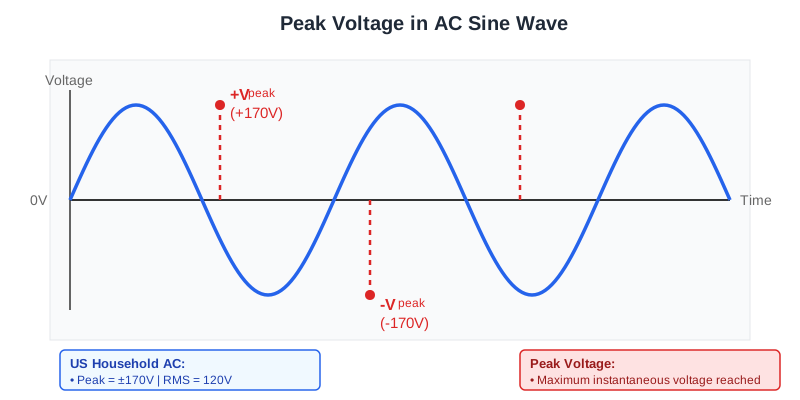
Peak value matters when checking insulation stress, capacitor voltage rating, diode reverse voltage, op-amp input range, ADC input protection, and oscilloscope headroom.
RMS Value
RMS means root mean square. It is the DC value that would produce the same heating effect in the same resistor.
For any periodic waveform:
$$
V_\text{RMS}=\sqrt{\frac{1}{T}\int_0^T v^2(t),dt}
$$
For a pure sine wave:
$$
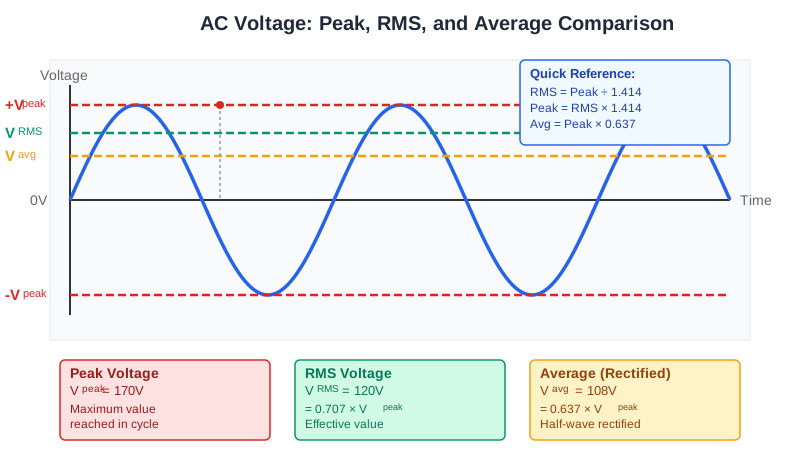
V_\text{RMS}=\frac{V_\text{pk}}{\sqrt{2}}=0.707V_\text{pk}
$$
and:
$$
V_\text{pk}=\sqrt{2}V_\text{RMS}=1.414V_\text{RMS}
$$
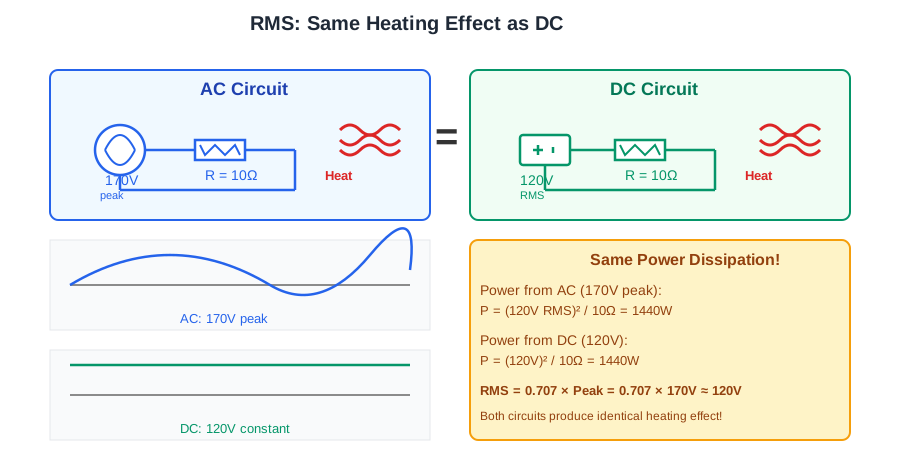
RMS is the value used for most AC power calculations:
$$
P=V_\text{RMS}I_\text{RMS}\cos\phi
$$
For a purely resistive load, cos phi = 1, so P = V_RMS I_RMS.
Average Value
The average of a symmetric sine wave over a complete cycle is zero because the positive half-cycle cancels the negative half-cycle.
$$
V_\text{avg, full cycle}=0
$$
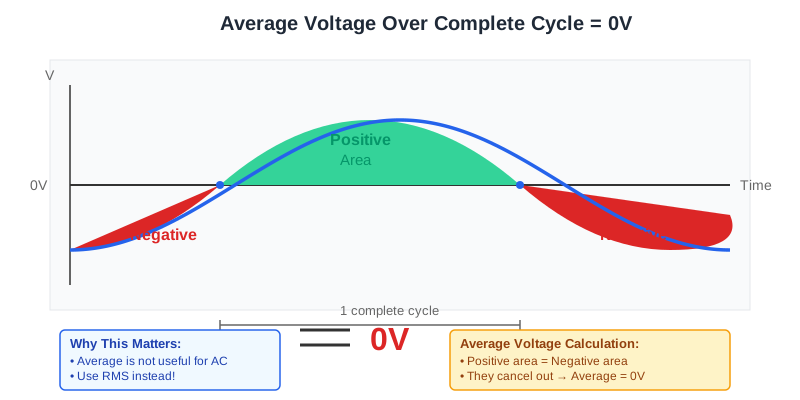
Average is still useful for rectified waveforms. For a full-wave rectified sine, the average of the absolute value is:
$$
V_\text{avg, rectified}=\frac{2V_\text{pk}}{\pi}=0.637V_\text{pk}
$$
For a half-wave rectified sine over a full cycle:
$$
V_\text{avg, half wave}=\frac{V_\text{pk}}{\pi}=0.318V_\text{pk}
$$
Worked Example: 120 V AC
For 120 V RMS sinusoidal mains:
$$
V_\text{pk}=120\sqrt{2}=169.7\ \text{V}
$$
$$
V_\text{pp}=2\times169.7=339.4\ \text{V}
$$
A 200 V capacitor is not enough margin for direct connection across this waveform. Practical mains circuits require isolation, protection, safety approvals, and correctly rated components.
Try It: RMS / Peak / Average Converter
Enter any one value to calculate the sine-wave equivalents.
Meter Readings and Waveform Shape
A true-RMS meter estimates heating-equivalent value even for many distorted waveforms within its bandwidth and crest-factor limits. A cheaper average-responding meter may assume the waveform is a sine wave. It can read incorrectly on PWM, chopped AC, rectifier outputs, inverters, and motor drives.
| Waveform | Important reading | Watch out |
|---|---|---|
| pure sine | RMS for power, peak for stress | peak is 1.414 times RMS |
| square wave 0 to 5 V | average and RMS differ by duty cycle | not centered around zero |
| PWM | average controls DC load, RMS controls heating | switching edges add EMI |
| rectified sine | average relates to DC output | ripple changes meter readings |
title "Sine measurement reference"
time start=0 end=20 unit=ms divisions=5

SINE: sine label="instantaneous v(t)" amplitude=1 cycles=1 unit=norm color=#2563eb
RMS: dc label="RMS level" value=0.707 unit=norm color=#16a34a
PK: dc label="peak level" value=1 unit=norm color=#dc2626
This waveform is illustrative and normalized.
Common Mistakes
- Treating RMS and peak as interchangeable values.
- Using
0.637 Vpkas the full-cycle average of an unrectified sine wave. - Selecting capacitors or semiconductors from RMS voltage instead of peak stress.
- Trusting an average-responding meter on a non-sinusoidal waveform.
- Forgetting that mains and inverter outputs are hazardous even when the RMS number looks familiar.
Summary
RMS describes heating-equivalent AC value, peak describes maximum instantaneous stress, peak-to-peak describes total swing, and average depends on whether the waveform is rectified or symmetric. For sine waves, V_RMS = V_pk / sqrt(2) and V_pp = 2 V_pk. Use RMS for power and current ratings, and use peak values for insulation, semiconductor, capacitor, and oscilloscope limits.
Further Reading
- Fluke: What is true RMS?
- All About Circuits: Measurements of AC Magnitude
- Tektronix: Oscilloscope Measurements