Sinusoidal Signals: Amplitude, Frequency, and Phase
A sinusoidal signal is the reference shape for AC analysis. Real signals can be distorted, noisy, or switched, but sine waves are the foundation for power, filters, impedance, phasors, and frequency response.
Learning Objectives
By the end of this lesson, you should be able to:
- identify amplitude, peak-to-peak value, period, frequency, and phase;
- use the relationship
f = 1 / T; - write a sine wave equation in time-domain form;
- explain why phase matters when comparing two signals;
- avoid confusing peak, peak-to-peak, and RMS values.
The Basic Sine Wave
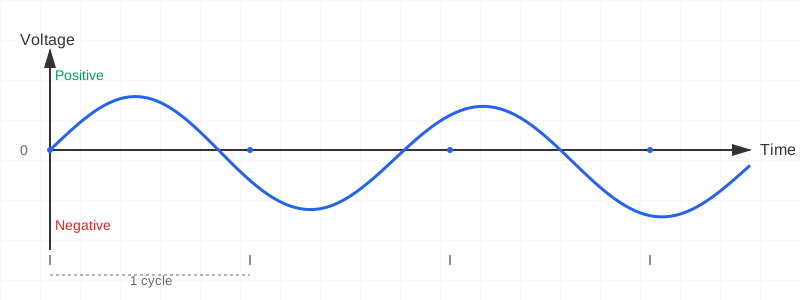
A common voltage sine wave can be written as:
$$
v(t)=V_\text{peak}\sin(2\pi ft+\phi)
$$
where:
V_peakis the peak amplitude;fis frequency in hertz;tis time in seconds;phiis phase angle.
Amplitude
Amplitude is the distance from the center line to the positive or negative peak.
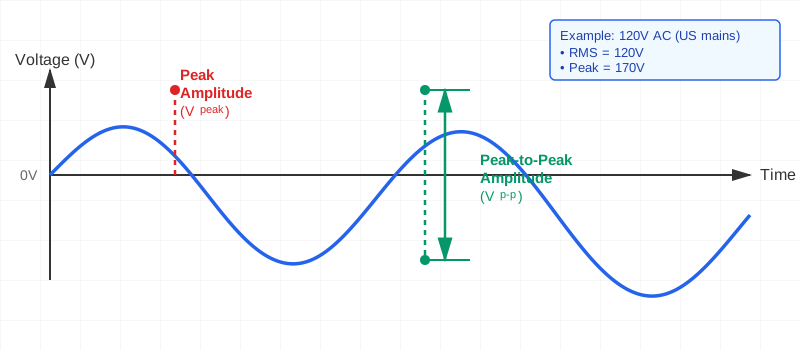
Related terms:
| Term | Meaning |
|---|---|
| peak | maximum magnitude from zero |
| peak-to-peak | positive peak to negative peak |
| RMS | equivalent heating value for a periodic waveform |
For a pure sine wave:
$$
V_\text{RMS}=\frac{V_\text{peak}}{\sqrt{2}}
$$
That is why 120 V RMS mains has about 170 V peak, and 230 V RMS mains has about 325 V peak.
Frequency and Period
Frequency is cycles per second. Period is the time for one cycle.
$$
f=\frac{1}{T}
$$
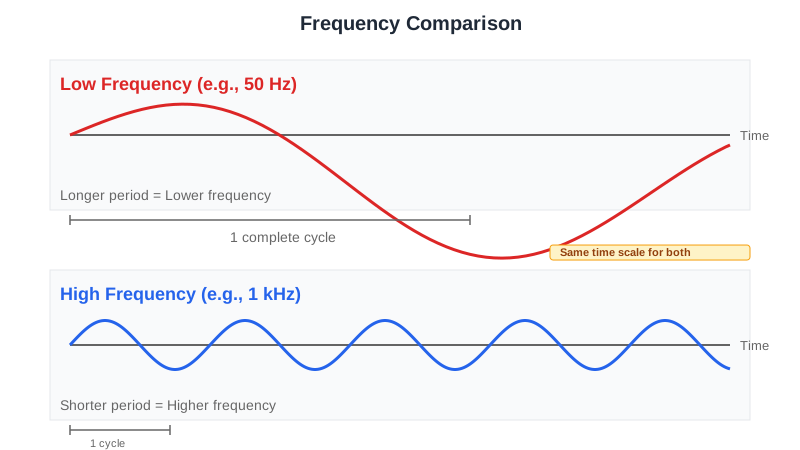
Worked Example
For a 50 Hz signal:
$$
T=\frac{1}{50}=0.02\ \text{s}=20\ \text{ms}
$$
For a 60 Hz signal:
$$
T=\frac{1}{60}=16.67\ \text{ms}
$$
Phase
Phase describes where a waveform is within its cycle relative to a reference.
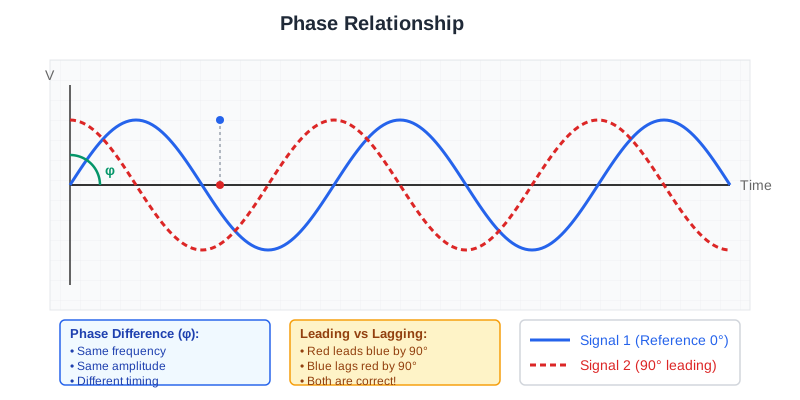
Two signals may have the same amplitude and frequency but still not reach their peaks at the same time. That timing offset is phase.
title "Two sine waves with a phase offset"
time start=0 end=20 unit=ms divisions=5

REF: sine label="reference phase" amplitude=1 cycles=1 unit=norm color=#2563eb
LAG: sine label="90 degree lag" amplitude=1 cycles=1 phase=-90 unit=norm color=#dc2626
This waveform is illustrative and uses normalized amplitude.
Why Phase Matters
Phase affects:
- power factor in AC power systems;
- filter response;
- motor torque in multi-phase systems;
- timing margins in communication and clocked systems;
- cancellation and reinforcement when signals combine.
Three-Phase Power
Industrial power often uses three sine waves separated by 120 degrees.
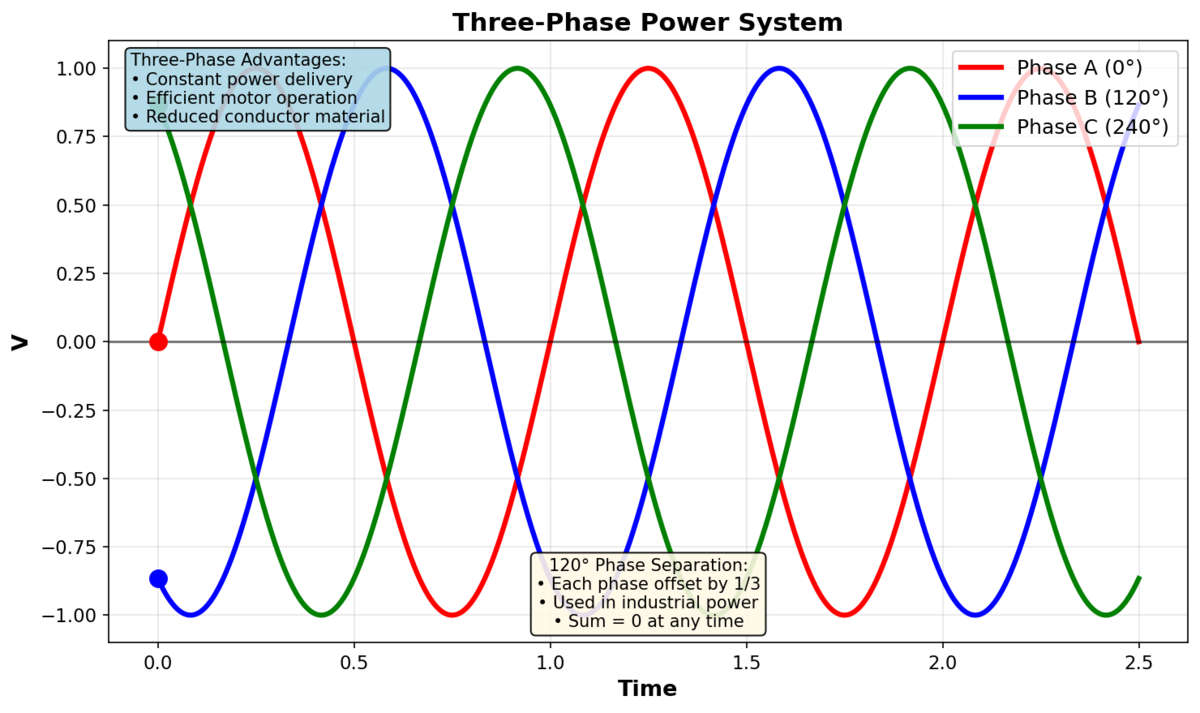
That spacing provides smoother power transfer and efficient motor operation.
Rotating Generators
When a coil rotates in a magnetic field, induced voltage varies approximately sinusoidally.
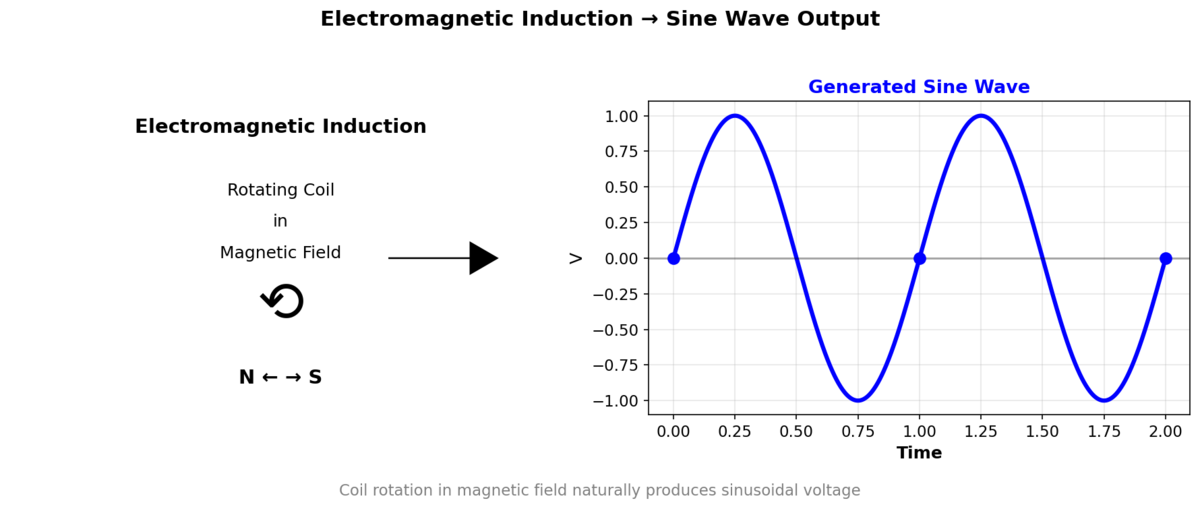
This is one reason sine waves are natural in AC power generation.
Common Phase Angles
| Phase | Interpretation for a sine reference |
|---|---|
0 degrees |
starts at zero and rises positive |
90 degrees |
starts at positive peak |
180 degrees |
inverted relative to reference |
270 degrees or -90 degrees |
starts at negative peak |
Common Mistakes
- Calling peak voltage and RMS voltage the same value.
- Forgetting that frequency and period are reciprocals.
- Comparing phase between signals of different frequency without defining the reference.
- Assuming every AC waveform is a perfect sine wave.
- Ignoring phase when calculating AC power.
Summary
A sinusoidal signal is described by amplitude, frequency, and phase. Frequency sets how fast it repeats, amplitude sets its size, and phase sets its timing relative to a reference. These ideas are the language of AC circuits, filters, motors, communications, and power systems.